

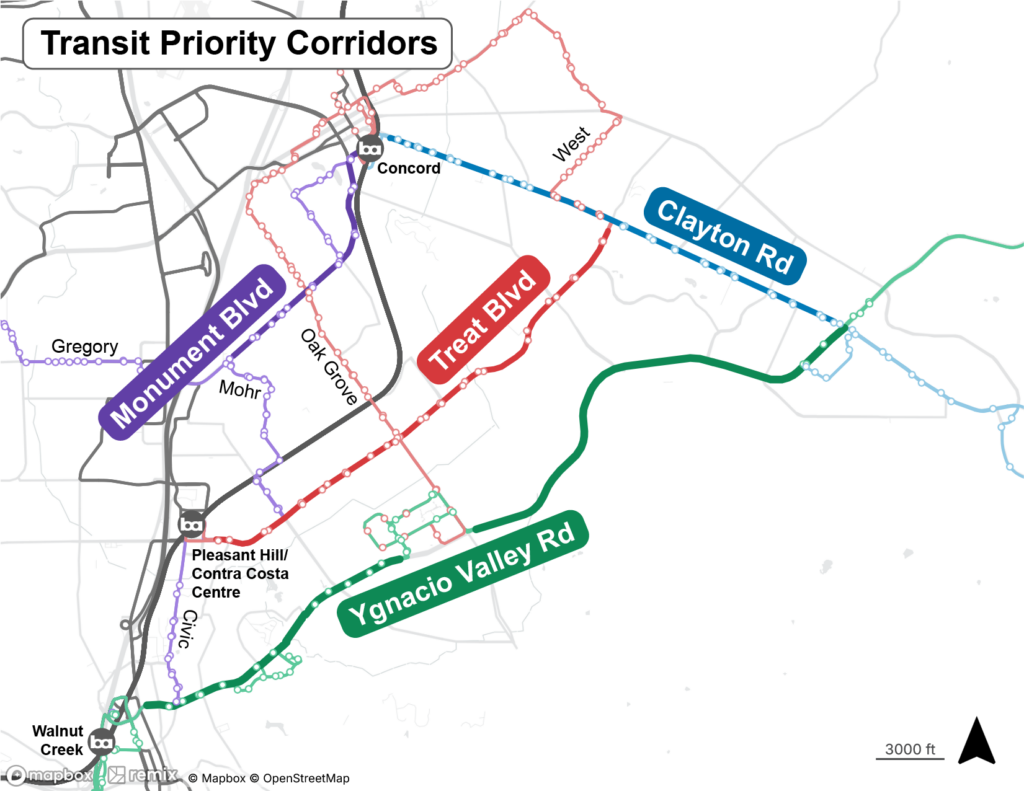
County Connection has completed a major Transit Corridor Study focused on one clear goal: making bus service faster, more reliable, and easier to use along some of our busiest corridors. The study examined four key streets in central Contra Costa County:
- Clayton Road (Routes 10, 15, 310, 315): Served by County Connection’s second-highest ridership route.
- Monument Boulevard (Routes 14, 16, 314): High transit propensity, serving an Equity Priority Community and an SB 535 Disadvantaged Community.
- Treat Boulevard (Routes 7, 11, 14, 15, 311): Serves multiple schools and retail destinations.
- Ygnacio Valley Road (Routes 1, 92X, 93X, 301): A congested corridor with healthcare, employment, retail, and some high-density housing, offering strong potential for transit development.
As traffic congestion has increased in recent years, buses have experienced longer and less predictable travel times. Riders told us they feel the impact: missed connections, inconsistent arrival times, and frustration when trips take longer than expected. This study was designed to understand exactly where delays occur — and identify practical, cost-effective solutions to fix them.
What information did our survey find?
The analysis showed that each corridor faces different challenges. Ygnacio Valley Road experiences the longest delays per trip because of heavy congestion and long waits at intersections. Treat Boulevard and Monument Boulevard have the highest overall passenger delay, meaning the greatest number of riders are affected by slowdowns. Clayton Road experiences steady, moderate delays, especially near major intersections.
One important takeaway is that transit challenges are not the same everywhere. Each corridor needs targeted improvements based on how and where delays occur.
Just as importantly, riders shared that reliability matters as much as speed. In our survey of more than 330 community members, people consistently emphasized the importance of dependable schedules, smooth BART connections, and safer, more accessible bus stops. Faster trips are important — but predictable service and a comfortable waiting environment matter just as much.
What will make the biggest difference?
The study found that traffic signals are one of the biggest causes of delay — and one of the biggest opportunities for improvement.
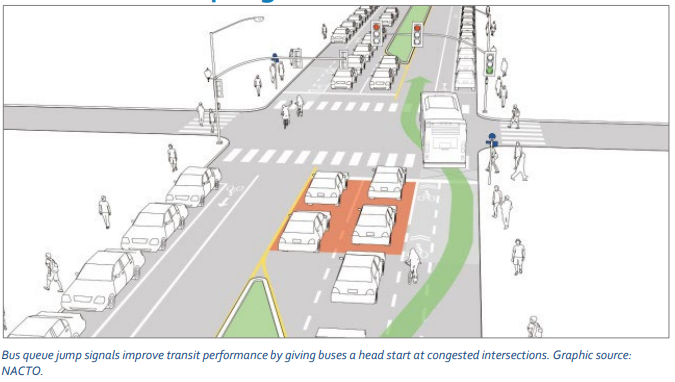
When buses stop at multiple red lights or get caught in long lines at intersections, travel times quickly add up. Adjusting signal timing, coordinating signals along entire corridors, and adding Transit Signal Priority (which allows buses to communicate with traffic signals to extend the green or shorten the red) can significantly reduce those delays. In some locations, adding short “queue jump” lanes (which let buses jump ahead of cars at traffic signals) or part-time bus-only lanes can help buses move ahead of traffic. These types of improvements consistently showed the strongest benefits in our analysis.
If fully implemented, the recommended improvements could reduce travel times by approximately 1½ to 4 minutes per trip on Clayton Road, Monument Boulevard, and Treat Boulevard — and up to 6 minutes per trip on Ygnacio Valley Road. While that may not sound dramatic at first, those minutes add up quickly across thousands of riders every day. More importantly, they create more reliable schedules and fewer missed connections.
Changes will happen in phases
The study outlines a clear roadmap for moving forward. The greatest improvements occur when strategies are combined. Updating signals, improving bus stop spacing, and adding targeted bus priority improvements work together to create meaningful, systemwide benefits. This phased approach allows County Connection to begin with high-impact, cost-effective strategies while planning for larger investments over time.
For many customers, small improvements in reliability can make the difference between catching a train on time or missing it. Over time, faster and more dependable service can also encourage more people to choose transit.
What happens next?
With the study complete, County Connection will begin working with local cities and partner agencies to refine designs, coordinate with planned roadway projects, and pursue funding for implementation. Signal-focused improvements will likely move forward first because they offer strong benefits relative to cost.
By combining technical analysis with rider feedback, County Connection is focused on delivering faster trips, more reliable schedules, safer stops, and stronger connections to BART and the broader community. As projects advance, County Connection will continue communicating with riders and the community to share updates and next steps.
Do you have questions or thoughts on this article you’d like to share? Email planning@cccta.org and we’ll be glad provide a response or hear what you have to say.