

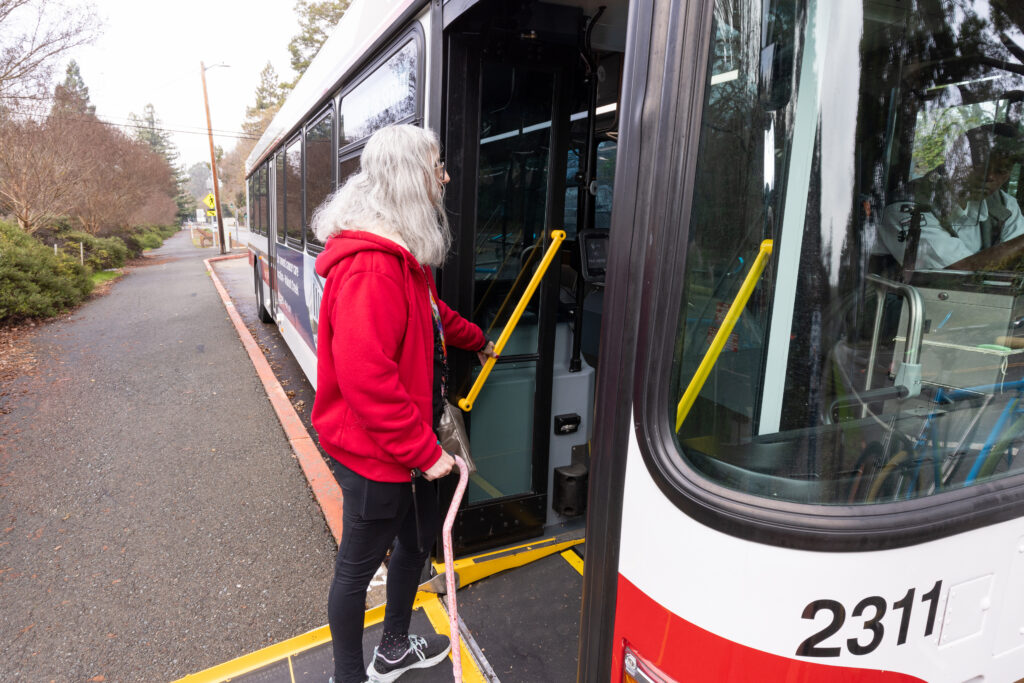
Have you noticed how easy it is to step onto a bus these days? Not too long ago, getting on the bus meant climbing up a steep set of stairs, which was not easy for a lot of people.
But for some riders, those steps weren’t just a hassle, they were a barrier. Parents juggling children and strollers, people using canes, and anyone carrying groceries all had to struggle to get on and off. And wheelchair users faced even greater obstacles, relying on slow-moving mechanical lifts, when lifts were available at all. In fact, the first lift-equipped bus route in the United States didn’t begin service until 1977 in San Diego. (Fun fact: in 1989, County Connection became the first public transit agency in the nation to operate a fully lift-equipped bus fleet.)
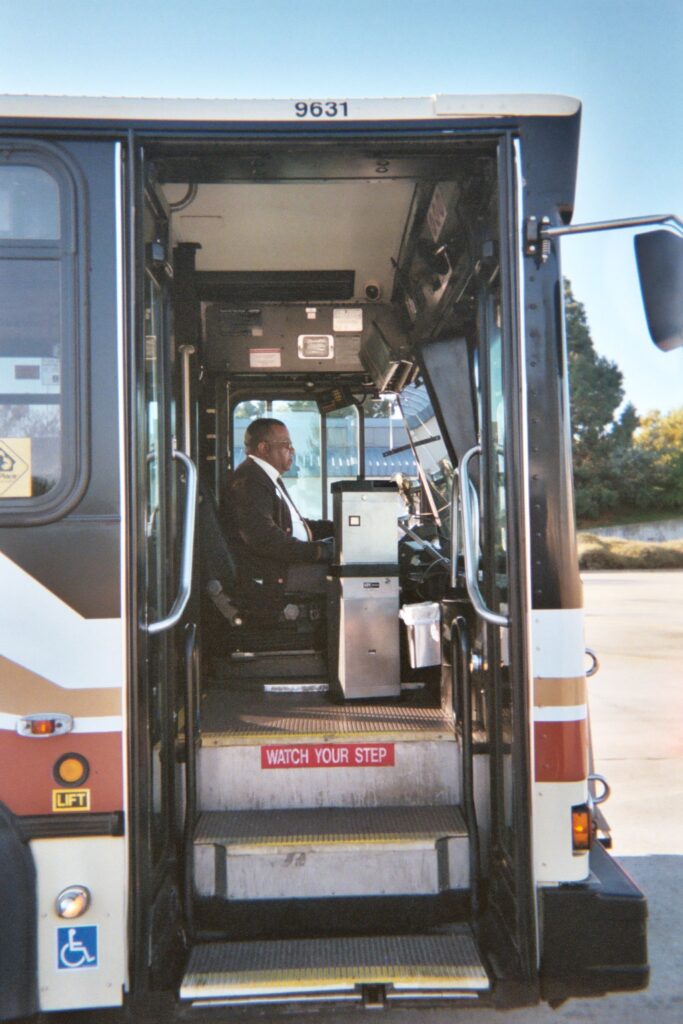
So, what happened to the stairs? Spurred on by the landmark Americans with Disabilities Act in 1990, the first low-floor bus hit the American market in 1991. Today, all major transit bus manufacturers make only low-floor buses, a modern and standardized all-access design. And that gets us to our original question: just what is a low-floor bus?
As the name would suggest, a low-floor bus has a floor that’s closer to the ground, but the real trick is the fold-out ramp, which allows people using wheelchairs, walkers, and other mobility devices to board independently. With the push of a button, the bus operator can quickly deploy a ramp through the front door that creates a smooth path from the sidewalk onto the bus. This simple feature makes boarding faster, easier, and more dignified for everyone.
And that’s the point: accessibility improvements benefit all riders. The same features that help wheelchair users also make life easier for everybody. Think about the sidewalk curb-ramp at a crosswalk when you’re rolling a suitcase or cart, an elevator for someone who has a hard time with stairs, or even the closed captioning on the televisions in a noisy sports bar; these were all features designed for accessibility that ended up helping everyone.
By redesigning the front suspension and steering system to make room for a low floor, modern buses have come a long way towards making transit accessible for everyone (think of it like remodeling a house—moving pipes and wiring behind the walls so you can replace a staircase with a ground-level entry)*. Simply stated, switching from steps to a ramp has improved mobility for millions.
*For all you fellow gearheads out there: Most bus manufacturers did this by replacing the solid front axle with independent front suspension and lowering the steering linkage to make way for the low floor. Not only did this increase passenger accessibility, but it also lowered the center of gravity and improved handling, just like a sports car (a sports bus?).
Andrew Smith is the Director of Planning & Marketing. Do you have question about County Connection? About our buses? About our routes and service? Email asmith@cccta.org and your question might be included in a future issue of our monthly newsletter, Headways.