News – County Connection

Real-Time Bus Arrival Signs Installed 

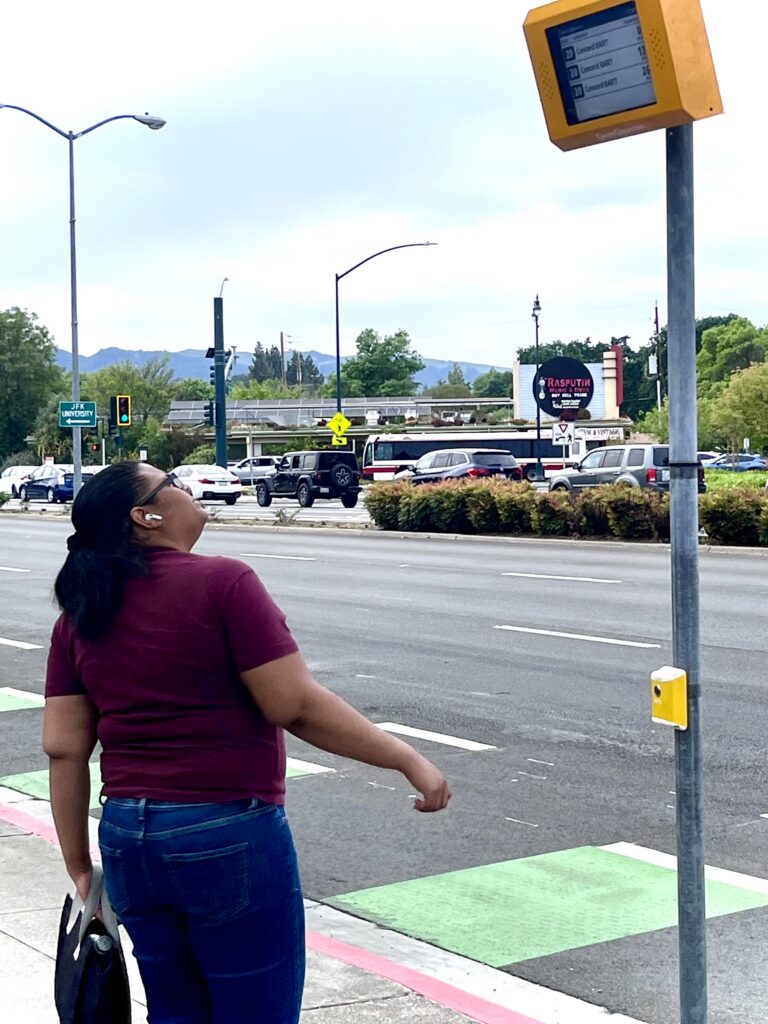
Real-time sign installed along Route 20, displaying County Connection bus arrival times.

Good news for County Connection riders—real-time bus arrival signs are now live at some of our busiest stops across central Contra Costa. If you’ve ever found yourself wondering, “Did I just miss the bus?” or “How much longer do I have to wait?”—we’ve got you covered. Our newly installed signs take the guesswork out of riding. How? They show exactly when your bus will arrive, with updates in real-time, roughly every minute. 

This upgrade builds on an earlier set of real-time signs first introduced in 2016. After seeing how helpful those were for riders, we evaluated what was working and looked for ways to make the passenger experience even better. The results are these 28 brand-new, modern displays designed with you—our riders—in mind.  

The new signs feature easy-to-read 13-inch e-paper screens (an easy-to-read low-power consumption display, similar to an Amazon Kindle e-reader) that stay clear and visible in all lighting conditions…whether you’re catching an early morning ride or heading home after dark. They’re also built to last, with vandal-resistant enclosures to keep them reliable for the long haul. 

Accessibility was a key part of this upgrade. Each sign includes text-to-speech functionality, making it easier for visually impaired riders to hear real-time arrival information with the push of a button (literally).  

You might notice these signs aren’t solar-powered like the previous ones—and that’s intentional. Advances in battery technology mean these displays can run for three to five years on a single battery, allowing us to install them in more locations without worrying about sun exposure or higher costs. 

We’ve placed the 28 signs where they can make the biggest impact by installing them at our stops with the greatest number of boardings. We also made sure to install at least one sign in each of the cities we serve where there is a stop averaging at least ten boardings per day. That means more riders in more places can benefit from real-time information. 

You’ll now find these signs in communities including Clayton, Concord, Pleasant Hill, Martinez, Moraga, San Ramon, Walnut Creek (coming soon), and Danville—at key stops along corridors like Clayton Road, Monument Boulevard, Contra Costa Boulevard, and Treat Boulevard, as well as near major destinations like medical centers, park-and-ride lots, and college campuses. 

You may notice that stops at BART stations and major transit centers aren’t included just yet. Those locations are part of a larger regional effort led by the Metropolitan Transportation Commission, with updates coming in the future. 

This project was funded through County Connection and delivered through a cooperative agreement with the California Association for Coordinated Transportation (CalACT), helping us bring this technology to riders efficiently and cost-effectively. Whether you’reheading to work, school, or anywhere in between, real-time information helps you plan with confidence. 

So next time you’re at the stop, take a look up—your bus may be close by (and now you’ll know exactly when it gets there). 


Have you seen one of our real-time signs? Whatdya think? We’d love to hear your feedback! Email your thoughts (and even photos of you with a real-time sign) to marketing@cccta.org.

Realignment, Improvements to Walnut Creek’s Route 4 

UPDATE: Route 4 service adjustments will be pushed back, taking effect on March 29, 2026.

County Connection is making a significant realignment and service enhancement to Route 4, the Walnut Creek “Downtown Trolley”, marking the first major redesign of the route in over two decades. The improvements are designed to streamline operations, enhance reliability, and provide more frequent service to support growing mobility needs in downtown Walnut Creek. 

For decades, Route 4—originally launched as Route 104—has served as a vital connector between Walnut Creek BART and the downtown core. Operated in partnership with the City of Walnut Creek, the service has long been fare-free and is often served by County Connection’s prototype Gillig electric trolley-themed buses. 

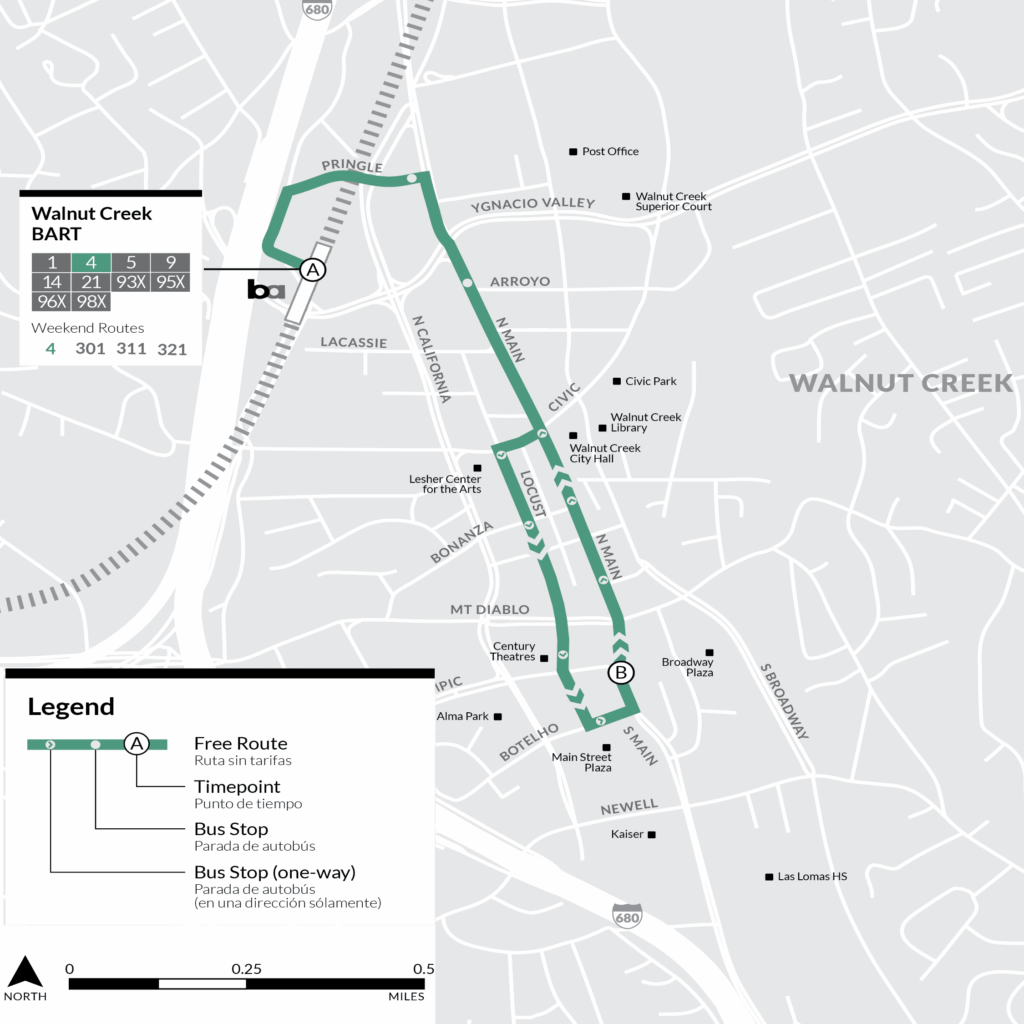
Image of the newly redrawn Route 3 service map.

Over the years, increasing traffic congestion, the addition of a figure-8 routing with the construction of Plaza Escuela in the early-2000s, and temporary routing changes made during the COVID-19 pandemic have created delays and reduced available charging time for the route’s battery electric bus fleet. To address these challenges, County Connection staff presented a proposal in 2025 to realign the route, optimize stop spacing, and take advantage of existing pedestrian infrastructure and the City of Walnut Creek’s transit signal priority (TSP) system, which gives more green lights to our buses. 

In addition to a new alignment, Route 4 will soon run every 15 minutes (previously every 20 minutes) on weekdays from 7 a.m. to 9 p.m.—an improvement funded through an Affordable Housing and Sustainable Communities (AHSC) Grant awarded in partnership with the City of Walnut Creek and Resources for Community Development for the Civic Crossing affordable housing development now under construction at 699 Ygnacio Valley Road. The grant provides up to $4.15 million to support increased bus frequency for approximately five years. 

“Route 4 has been a cornerstone of mobility in Walnut Creek for decades,” said Bill Churchill, County Connection General Manager. “This realignment ensures the service can continue to meet the needs of residents, workers, and visitors while improving reliability.” 

As part of County Connection’s federal responsibilities under Title VI of the Civil Rights Act, a major service change analysis was conducted to ensure the proposal does not disproportionately impact minority or low-income riders. The Title VI Service Equity Analysis found no disparate impacts or disproportionate burdens and projected a net increase in service for both groups. 

Public outreach efforts began in September 2025, including opportunities for riders to provide feedback via email, mail, and online. A public hearing was held on October 16, 2025, prior to the County Connection Board of Directors meeting. All feedback received wasincorporated into the final Title VI report submitted to the Federal Transit Administration. 

Planned changes to Route 4 will begin on January 11, 2026. (Update: Route 4 service adjustments will be pushed back, taking effect on March 29, 2026.) “Changing any route or service is an enormous endeavor,” explained Andrew Smith, Director of Planning & Marketing, “and one that takes a lot of thoughtful coordination between County Connection, the City, various funding sources, and the public.” 

This realignment ensures that Route 4 remains a dependable and accessible link for everyone traveling through downtown Walnut Creek. 


Community Resources in Contra Costa

Image of crisis resource graphics

Navigating your way through the holiday season can be challenging for some. County Connection is committed to public service and knows that besides needing an affordable transit option, there are those who may need help in other ways.

If you or someone you know is experiencing food insecurity, looking for shelter, or are in need of crisis counseling support, there are resources available in Contra Costa:

COUNTY CONNECTION RESOURCES

Safe Place Logo
  • Safe Place (1-800-786-2929) – All County Connection buses serve as a Safe Place for youth in crisis. A Safe Place is a designated place that can help youth in crisis by connecting them with available resources. If you are a youth in crisis, find a County Connection bus and tell them you are in need of help. Other ways to get help:
    • Phone – text the word SAFE and your current location (address, city, state) to the number 69866. You will receive a message with the closest Safe Place location. You will also have the option to text interactively with a professional for more help. It’s quick, confidential, and safe.
    • Speak to someone on the phone by calling the National Runaway Safeline at 1-800-RUNAWAY (1-800-786-2929).
    • Safe Place is not intended to replace 911 in emergency situations.  If you are in immediate danger, please call 911.
  • Free Routes – County Connection offers ten free routes (marked green) to any passenger. These routes travel around Central Contra Costa County and can connect you to resources.

FOOD INSECURITY

  • Food Bank of Contra Costa & Solano (multiple locations) – Free food is available near you! Click here to see a map of Food Distribution Sites (listed by city) to find a location or call 855-309-3663.
  • Loaves and Fishes of Contra Costa (multiple locations) – Loaves and Fishes of Contra Costa Operated Dining Rooms are open to the public and serve anyone that is in need of food. There are dining rooms located in Antioch, Martinez, Oakley, Pittsburg, and Walnut Creek. Click here to find a meal near you.
  • GROW (Grass Roots Outreach Warriors) (Concord) – GROW not only provides meals to whomever needs it (6 days a week), they also offer laundry and hygiene services, as well as providing supplies such as clothing and pet supplies. Dinner served:
    • Baldwin Park, 2727 Parkside Circle in Concord (Port Chicago Hwy & Bonifacio)
      Sunday, Tuesday, Thursday @ 4pm
    • Cowell Park, 3501 Cowell Road in Concord (Cowell Road, just west of Babel)
      Monday, Wednesday, Friday @ 4pm
  • Monument Crisis Center (1990 Market Street, Concord) – The food distribution program provides stability for low income and at-risk individuals and families in Contra Costa County. Distribution is Monday-Wednesday, 9am-Noon.
  • Hillcrest United Church of Christ (404 Gregory Lane, Pleasant Hill) – Hillcrest Community Service Programs offers a food pantry, clothing room, and care ministries for those in need.

CRISIS COUNSELING

  • Contra Costa Crisis Center (Walnut Creek, Call 988 or 1-800-273-8255) – Seek culturally relevant resources and assistance for yourself or others in need of crisis or suicide prevention, and grief counseling.
  • Rainbow Community Center (Concord, non-crisis intake line 925-692-2056) – Provides clinical and peer groups for LGBTQIA2S+ to promote acceptance, bring people together, and improve communication.
  • 988 Suicide & Crisis Lifeline (nation-wide, call 988) – 988 has been designated as the three-digit dialing code that will route callers to the National Suicide Prevention & Mental Health Crisis Lifeline, 24 hours a day, 7 days a week, across the United States.
  • NAMI Contra Costa – Provides support, outreach, education and advocacy to individuals living with and families impacted by mental illness. 

SHELTER

  • Contra Costa Health, Adult and Youth Homeless Services (call 211 or text “HOPE” to 20121) – Contra Costa Health’s Health, Housing and Homeless Services provides a number of services to support unhoused people.
  • Shelter Inc. (Pleasant Hill, 925-435-2074) – Rebuilding lives one family at a time, by helping reestablish a home, and assisting with the skills and resources families need to live the life they deserve.
  • Winter Nights Family Shelter (Pleasant Hill, 925-435-2074, info@cccwinternights.org) – The Winter Nights Family Shelter serves families with children, including shelter, meals, transportation, day tutors, counseling and a parking lot program.

ADDITIONAL RESOURCES


If you know of other community resources available in Contra Costa County or would like to make a suggested edit to the list above, please contact the County Connection Marketing Department, marketing@cccta.org.

East Bay Small Operators Applaud Passage of SB 63 

CONCORD, CA – East Bay bus transit operators County Connection, LAVTA (Wheels), Tri Delta Transit, and WestCAT applaud California lawmakers for approving the Connect Bay Area Act, Senate Bill 63 (SB 63). The bill paves the way for a regional funding measure that could stabilize transit service for millions of Bay Area riders, including thousands who depend daily on the Tri-Valley and Contra Costa County’s bus systems. 

SB 63 authorizes a Public Transit Revenue Measure to be placed on the November 2026 ballot if sufficient voter signatures are collected. The measure would establish a half-cent sales tax in Alameda, Contra Costa, Santa Clara, and San Mateo counties, and a one-cent sales tax in San Francisco, creating a sustainable funding stream to preserve and expand essential transit service. 

“This is a turning point for East Bay bus operators,” said Bill Churchill, General Manager of County Connection. “For too long, bus operators like ours have stretched every dollar just to maintain basic service. SB 63 has the potential to provide stable, long-term funding that allows us to maintain essential services and respond to new demands. With this support, we can better serve our riders, reduce congestion, and meet climate goals.” 

For smaller transit agencies, SB 63 could mean the difference between cutting essential services and building a system that meets the needs of a changing region. 

“SB 63 gives our communities a chance to secure reliable funding that ensures students can get to school, seniors can access essential services, and workers can depend on us to reach their jobs,” said Christy Wegener, Executive Director of the Livermore Amador Valley Transit Authority, provider of Wheels services. “It’s about protecting the everyday trips that keep the Tri-Valley moving.” 

Without new revenue, many East Bay operators would face difficult decisions about reducing service – cuts that would hit transit-dependent riders the hardest. 

“The mobility needs of Contra Costa County’s most vulnerable populations depend on frequent, safe and reliable bus service,” said Rashidi Barnes, CEO of Tri Delta Transit. “SB 63 is a vital step toward ensuring we can provide equitable, safe, and consistent transportation in Eastern Contra Costa—where transit is essential to both economic mobility and quality of life. This bill brings real hope to the people we serve.” 

“WestCAT plays a unique role in connecting riders in Western Contra Costa to the broader Bay Area,” said Rob Thompson, General Manager of WestCAT. “Sustainable funding from SB 63 means we can protect these lifeline services, expand where demand is growing, and invest in cleaner, greener buses. It’s a smart investment in equity, the economy, and the environment.” 

The Tri-Valley and Contra Costa transit partners extend appreciation to Senators Scott Wiener and Jesse Arreguin for authoring the legislation, Governor Gavin Newsom for his leadership, and the region’s legislative delegation for continued support of transit riders.  


Media Contacts: 

County Connection 
Ryan Jones | rjones@cccta.org | 925-680-2037 

Wheels 
David Mark | dmark@lavta.org | 925-455-7553 

Tri Delta Transit 
Leeann Loroño | llorono@eccta.org | 925-754-6622 

WestCAT 
Mica McFadden | mica@westcat.org | 510.724.3331 

Youth Ride Free This Summer on Four East Bay Transit Agencies   

CONCORD, CA – Four East Bay transit agencies—County ConnectionTri Delta TransitWestCAT, and Wheels—are working to bring more young riders to public transit with their free youth promotions going on throughout the summer. From June 1 through July 31, youth aged 18 and under can ride for free on County Connection, Tri Delta Transit, and WestCAT, while Wheels offers its Summer Youth Ride Free for a second year with the promotion through August 31.

This collaborative initiative aims to increase transit use by making public transportation more accessible, especially for youth navigating summer social and work options. 

“For Tri Delta Transit, this pilot lowers barriers and connects youth to summer jobs and programs—on our system and beyond,” said Rashidi Barnes, CEO of Tri Delta Transit. “There’s a whole world in California accessible by transit.”

In addition to increasing mobility, the pilot gives agencies a chance to better understand youth travel behavior. Ridership data is collected as youth board, and some agencies may have opt-in surveys, helping to provide a picture of the youth demographic and their travel habits, informing future planning and service decisions.

“It’s essential to build a new generation of riders,” said Rob Thompson, General Manager of WestCAT. “Youth can explore local systems and connect to others—like AC Transit, BART, and even ride our Lynx express to San Francisco, for free.”

“Wheels’ Summer Youth Ride Free program was a hit last year,” added Christy Wegener, Executive Director of LAVTA. “Now, with our neighboring agencies on board, we’re expanding that reach—helping youth connect in person and travel to jobs, getting them off their screens and out into their communities.”

This unified effort comes at a critical time—following a reallocation of funding and the recent discontinuation of the Summer Youth Pass. In its absence, these fare-free programs fill an essential gap, supporting not only youth mobility but also helping families who rely on public transportation during the summer months when school is out.

“The Youth Ride Free initiative helps us rethink how to serve young riders,” said County Connection General Manager Bill Churchill. “We’re excited about the data we collect–and even our new Youth Ride Free leaderboard–will inform future youth-focused programs.”

At the end of summer, Contra Costa and Tri-Valley youth can continue their transit journeys by utilizing a Youth Clipper pass which offers discounted fares across all Bay Area transit.

For more information about each agency’s free youth ride programs:


County Connection Launches Youth Ride Free Pilot Program   

Youth Ride Free gif

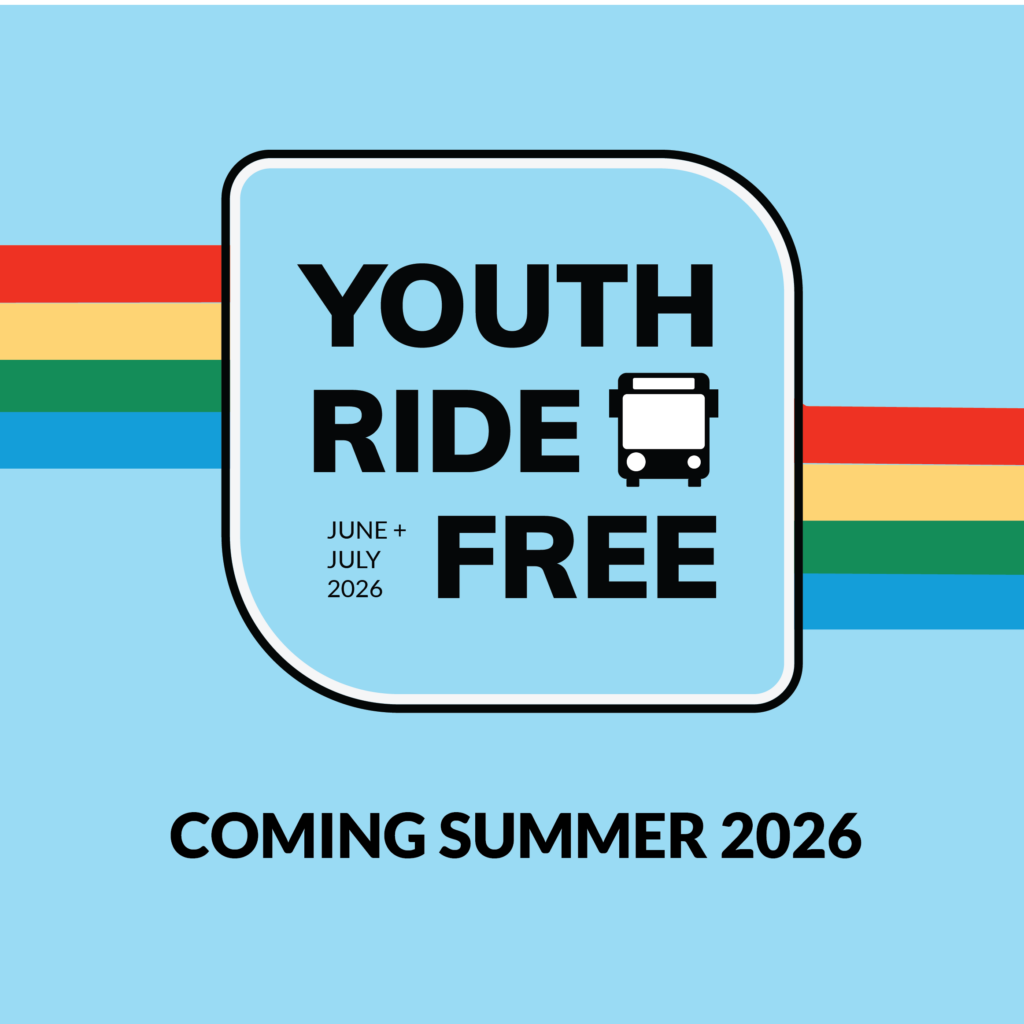
Regional summer travel just got a whole lot better for area youth! County Connection is thrilled to announce the launch of the Youth Ride Free pilot program, which will offer fare-free rides on all County Connection bus routes for youth up to 18 years of age, starting June 1 through July 31. Young riders can simply board without the need for an application or special pass, making access to public transit easier than ever. 

The Youth Ride Free program is designed to familiarize young riders with public transit and promote regular bus use, while also allowing County Connection to learn more about where its youth riders want to go. By eliminating fares and an application process, County Connection is removing obstacles that have historically prevented youth from fully utilizing public transportation.  

“Our goal is to create life-long transit users, either on our system or elsewhere,” says Kevin Wilk, Board Chair of County Connection. “Encouraging and understanding youth travel behavior are key to this pilot. While previous efforts to lower youth fares have shown some positive results, we need to gain a clearer picture of travel habits–especially among those who may hesitate to fill out an application, by reducing barriers to youths riding public transit.” 

Neighboring transit agencies implementing similar programs experienced substantial increases in youth ridership (ranging from 15% to 154%) during the summer of 2024.Transitioning to a fare-free system not only encourages more trips from low-income riders but also enhances bus service efficiency and reduces costs associated with fare collection.  

During the summer months, this free transit initiative is also expected to greatly enhance mobility for young people, allowing them to access vital resources such as libraries, parks, shopping centers, and summer job opportunities. Additionally, the program aims to reduce social isolation, foster greater transit literacy, and promote increased physical activity among youth.  

Previous programs like the Summer Youth Pass (which has been discontinued) and Pass2Class have facilitated youth access to public transit; however, ridership trends have not shown significant growth in the years since COVID. The Youth Ride Free program aims to change that dynamic.  

“With this pilot, we recognize the need to adapt to the changing demands of our young riders,” Bill Churchill, General Manager of County Connection. “This initiative encourages us to think creatively about how we can meet their travel habits by incentivizing changes in travel behavior. Regardless of the pilot’s outcome, the data we’re able to collect will help inform future programs.”  

In addition to tracking youth ridership, County Connection plans to collect passenger feedback through opt-in surveys, providing young riders with a platform to share their experience. However, providing free transit does come with financial implications. For County Connection, funding this pilot as a research initiative will inform future planning efforts and help determine the feasibility of sustaining a youth transit program in the long term. 

At the conclusion of the Youth Ride Free pilot in July, area youth will have the opportunity to register for Pass2Class, a program offered by 511 Contra Costa that requires an application and offers two months of free transit on County Connection buses. Following the pilot, County Connection staff will share data and insights with partnering agencies to ensure alignment and collaboration in future initiatives aimed at engaging our youth riders.  
 
For more information on the Youth Ride Free program, visit countyconnection.com/yrf/ 


County Connection, Behind the AdWheel Award 

You may be familiar with the Oscars and Grammys, but the AdWheel Award is a lesser-known accolade celebrated in the public transit marketing sphere. The AdWheel is a coveted recognition by the American Public Transportation Association (APTA)–and County Connection is a 2025 recipient. Woot! 

The AdWheel Awards are presented annually at the APTA Marketing, Communications, & Customer Experience Workshop, which takes place at various locations across the nation. The awards recognize excellence in three main categories:  

  • Best Marketing and Communications on Workforce Development 
  • Best Marketing and Communications to Increase Ridership or Sales 
  • Best Marketing and Communications Educational Initiative  

Each category features five subcategories based on platform or marketing format, including print media, electronic media, special events, social media, and comprehensive campaigns. Agencies must submit applications and, when applicable, samples of their campaigns, months in advance to be considered for an award. 

This year, County Connection won the AdWheel Award for Best Marketing and Communications on Workforce Development (Social Media) for our March 2024 campaign in honor of Transit Operator & Worker Appreciation Day. This annual event recognizes the contributions of those who not only drive our buses, but keep them clean and operational, providing essential service to our community. 

About our 2024 Campaign 

For our 2024 campaign, County Connection’s marketing team invited passengers to submit messages of appreciation for our transit workers through an online form. We received nearly 100 submissions, which staff used to create a graphic template that included the sender’s first name, age, and city alongside their message. We also highlighted our transit workforce by preparing posts featuring photos of three County Connection staff members representing our operators, maintenance team, and customer service team. Transit Operator & Worker Appreciation Day took place on March 18, 2024 (and every March 18), and the graphics from our award-winning campaign were shared throughout the day on social media. 

County Connection is proud to receive this recognition and aims to show our workforce how much they are valued, particularly as the public transit industry seeks to fill vacant positions. (BTW, we’re hiring!

Submit a message for our Appreciation 2025 campaign 

We’re repeating our efforts again this year and putting out a call for messages that we can share with our transit workforce. This year, you may submit a message (such as “Thanks for greeting me each morning”), or include a photo or video, and even haikus are welcome from those feeling poetic for transit workers! We will select as many submissions as possible to share (and tag if you wish) on our social media pages. 

Thank you for helping us celebrate the dedicated individuals who make public transit possible! 


Hold onto Your Hats–it’s Roadeo Time! 

Maybe this ain’t your first Roadeo (yes, that’s how it’s spelled). But if it is, buckle up: in public bus circles, the International Bus Roadeo, run by the American Public Transportation Association (APTA) is the ultimate test of skill. A Roadeo is a bus-handling competition held annually, challenging public bus agencies to pit their top operators against an obstacle course of hard turns, quick stops, and serpentines—all timed, of course. For most operators, however, it is just another day at the office. 

Image of a bus negotiating the Rear Duels Clearance, obstacle 1.
Roadeo judge looking on as County Connection bus negotiates the Rear Duels Clearance, Problem 1. (County Connection/Andy Smith)

To qualify for the International Bus Roadeo, held this year in Austin, TX, agencies must first hold their own competitions, adhering to the same judging criteria, and course problems. County Connection hosts its competition in late Winter/early Spring, inviting any staff with a Class B driver’s license to participate. But only an APTA-qualified* operator winner can advance to the international stage.  

Like County Connection, many agencies turn their local competitions into mini-industry-only events, inviting partner agencies for judging, food trucks, and even a bounce house for the kids—all fostering a spirit of camaraderie and friendly rivalry. And yes, there is a good chance for everyone to ride through a bus wash while singing “The Wheels on the Bus”—pure joy for both kids and kids-at-heart! 

On the international stage, local competition winners face off against other top operators from around the country for the top prize. The operator with the highest score receives a trophy, Champion Ring, and $1,000. In addition to navigating the obstacle course, participants are evaluated on personal appearance and complete a pre-trip inspection of the bus—a true test of expertise. 

Graphic of County Connection Roadeo course.

 While a simple left or right turn may seem easy, bus drivers navigate these 13-ton, 30–40-foot long vehicles daily, maneuvering through bustling freeways and narrow streets. Add in unexpected challenges like accidents or animals darting across the road, and the demands become clear. Bus operators possess skills often overlooked, or at least not easily noticed. With each trip, they must balance precision, quick thinking, stellar customer service, and a high level of professionalism. It’s no wonder so many agencies strive for excellence at the APTA International Bus Roadeo, displaying the remarkable skill set required to sit behind the wheel of a bus.  

Image of a driver in a bus, working through the Roadeo obstacle course.
County Connection operator finishing the final obstacle, the judgement stop. (County Connection/Ryan Jones)

In a time when County Connection and the public transit industry grapple with financial sustainability, recover ridership lost during the pandemic, and strive to fill numerous vacant operator positions, the Roadeo represents more than just a contest. It’s a point of pride for agencies; a reminder that while competition can be fierce, it’s the everyday dedication of operators that truly keeps our communities moving safely.  

For over 25 years, County Connection has proudly sent over 10 operators to compete nationally, many of whom competed more than once. The agency also has the top female driver, who in 2010 ranked in at #4 nationally, and is still the top-scoring female competitor.  

So, as drivers tackle the Roadeo gauntlet, both on small and big stages, they also reflect the real-life obstacles they face daily—because in the world of bus driving, every day can feel like a Roadeo. 

*To be APTA-qualified, operators must not have had any accidents, suspensions, or attendance warnings in the year prior to competing.  


Schroder legacy on display with building dedication 

Concord, CA — County Connection is proud to announce the dedication of the Schroder Administration Building to honor Robert (Bob) Schroder and his son, Robert (Rob) Schroder, for their exceptional service to the community and their unwavering commitment to public transportation in Contra Costa County. The dedication ceremony was held Thursday, December 19, 2024 at County Connection headquarters in Concord.

Image of Rob Schroder in front of Schroder Administration Building at County Connection.
Rob Schroder speaking with well-wishers in front of newly christened Schroder Administration Building at County Connection.

Bob Schroder (1928-2019) was a businessperson, civic leader, and founding father in establishing the Central Contra Costa Transit Authority (County Connection), serving on its Board of Directors from 1980 to 1998. Additional notable roles include serving 16 years on the Walnut Creek City Council, 16 years on the Contra Costa County Board of Supervisors, and holding a seat on the Metropolitan Transportation Commission. 

Bob’s foresight allowed for broader collaboration among local cities, making public transportation more accessible for all East Bay residents. His dedication earned him the nickname “Mr. Transportation” and led to his legacy being immortalized with the “Robert I. Schroder” bridge over Treat Boulevard. 

Bob’s son, Rob Schroder, recently retired from the County Connection Board of Directors, where he served from 1998 to 2024, while also serving as mayor and councilmember for the City of Martinez. His extensive contributions encompass transforming city finances, revitalizing parks and public facilities, and launching initiatives that support local businesses; solidifying his status as a true champion for the community and its residents. 

“For the first time in 44 years, we will not have a Schroder sitting on our Board of Directors,” quipped Bill Churchill, General Manager of County Connection. “The Schroders embody the essence of civic leadership, and they recognized that advocating for public transit is a vital investment in both economic and community growth.” Churchill, who has been with the Authority for 30 years himself, working with both Bob and Rob, continued, “In public transit, we strive to ensure there’s reliable and accessible transit for all. The Schroders truly understood that mission.” 

The Schroder Administration Building will stand as a tribute to Bob and Rob Schroders’ time, talents, and shared vision for enhancing public transportation and community development in Contra Costa County. 

County Connection Secures $15.9 Million Grant for Solar and Service Modernization Project 

Concord, CA – County Connection has been awarded $15.9 million from the Transit and Intercity Rail Capital Program (TIRCP) to fund the innovative Solar Supported Zero Emission Vehicle Fleet and Service Modernization Project. This transformative project aims to enhance public transit services while significantly reducing greenhouse gas emissions, particularly benefiting disadvantaged and low-income communities within the County Connection service area. 

The project proposes the installation of 90,000 square feet of solar panels and a microgrid battery storage facility to support the acquisition of future zero-emission buses (ZEBs) that will replace outdated diesel-powered buses. 

“This funding will strengthen the foundation of our zero emission programs and commitment to ensuring safe reliable and clean public transportation for our Contra Costa residents,” said Kevin Wilk, Walnut Creek City Councilmember and the Chairman of County Connection Board of Directors. 

The project is particularly important as it aligns with California’s strict air quality regulations. In 2023, County Connection’s Board of Directors adopted a plan to transition to a fully zero-emission bus fleet, in accordance with California Air Resources Board (CARB) regulations requiring all new buses purchased after January 1, 2029, to be zero-emission vehicles. The initial phase will focus on acquiring 27 additional ZEBs, set to replace diesel buses which will be at the end of their useful life. 

The TIRCP funding will not only support critical infrastructure upgrades at the main bus depot in Concord but will also enhance the facility’s resilience against future power grid disruptions. The on-site solar power generation and battery storage will significantly lower emissions, reinforcing County Connection’s commitment to a sustainable future. 

“We are always looking toward the future and for new ways to offer reliable public transit to the communities we serve,” said Bill Churchill, General Manager at County Connection. In total, the project is estimated to cost $48.9 million, with this grant award leveraging additional state and federal funds. 

The anticipated greenhouse gas emission reduction is substantial, with projections indicating a reduction of 40,372 metric tons of CO2 equivalent (MTCO2e), highlighting the project’s critical role in reducing greenhouse gas emissions. 

Media inquires, please contact Ryan Jones, Manager of Marketing & Communications, County Connection at rjones@cccta.org or call 925-680-2037.