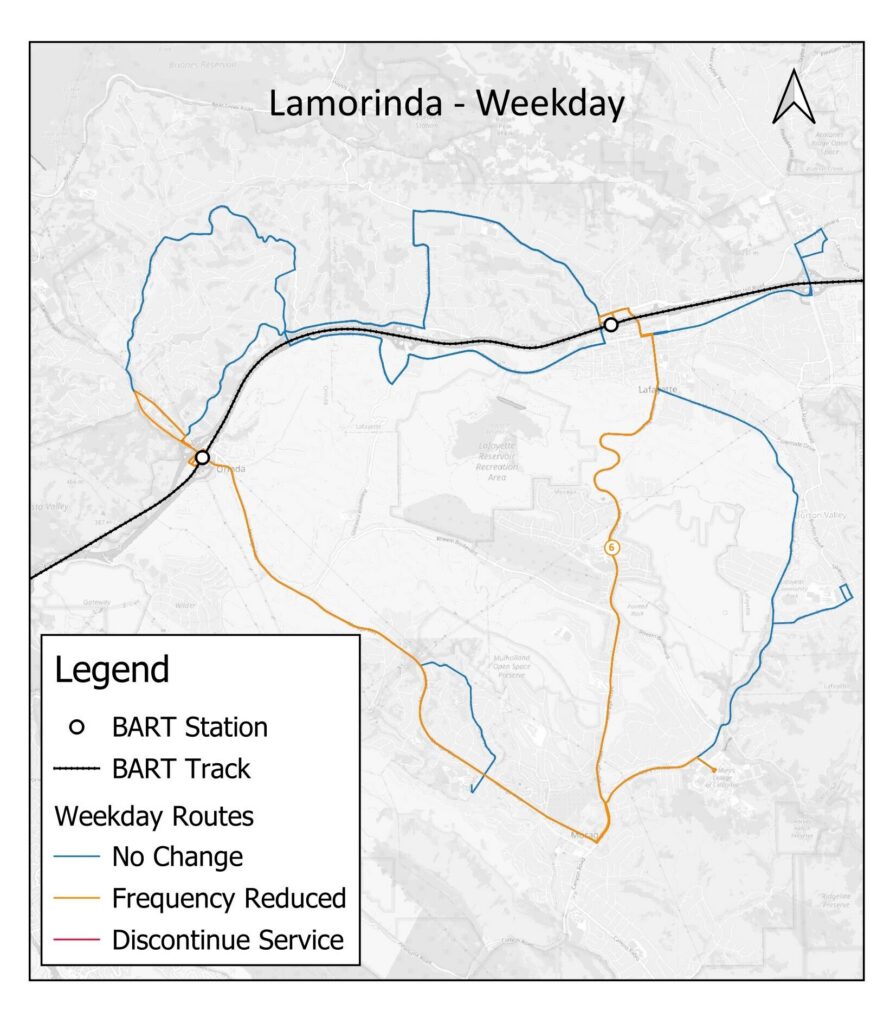
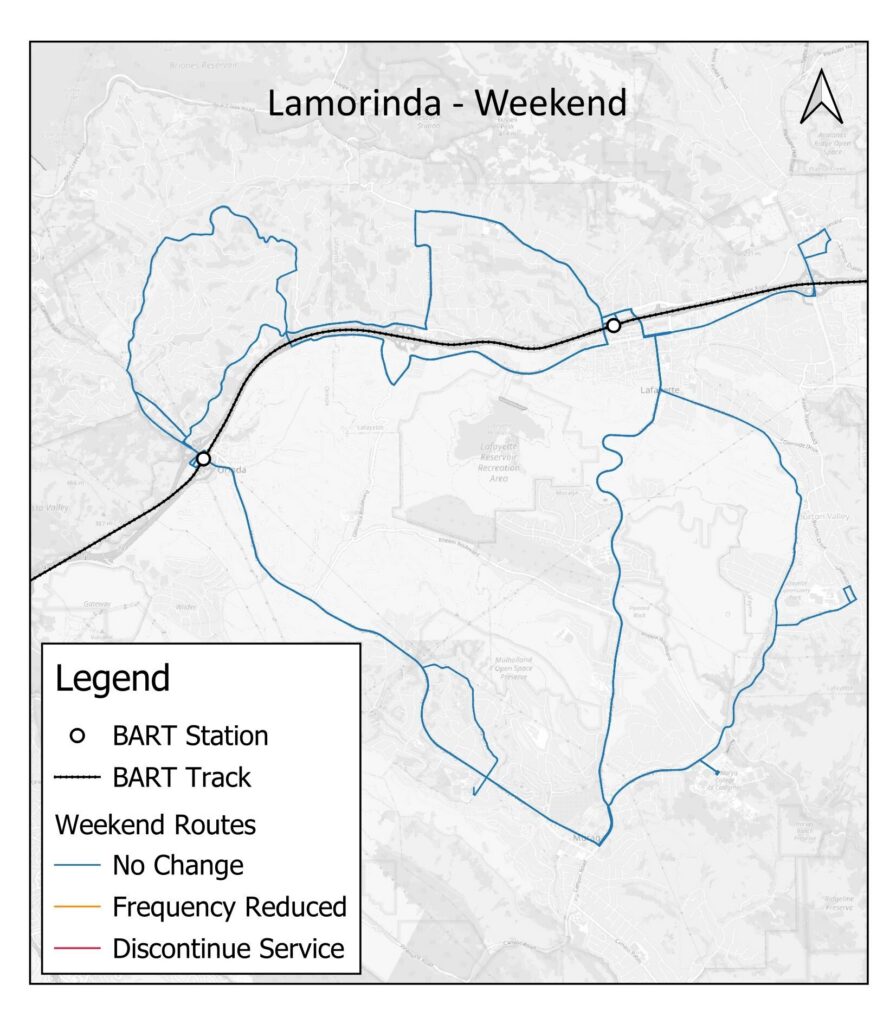
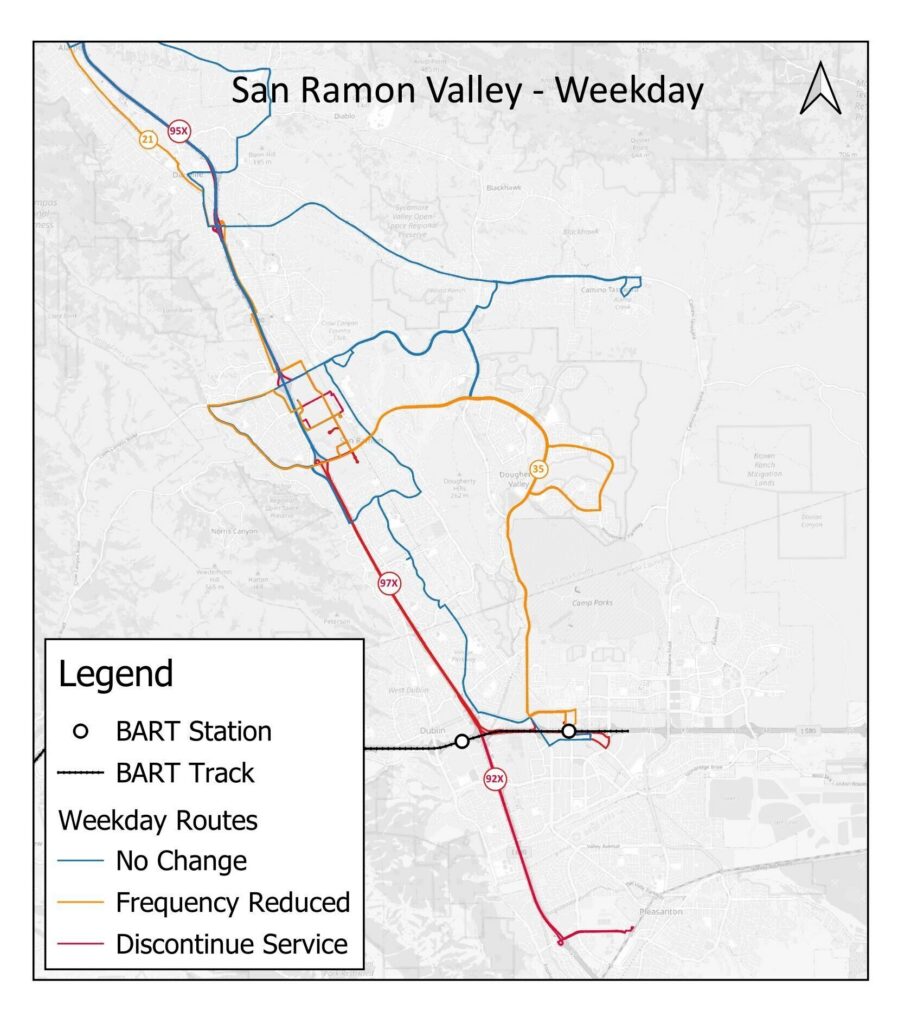
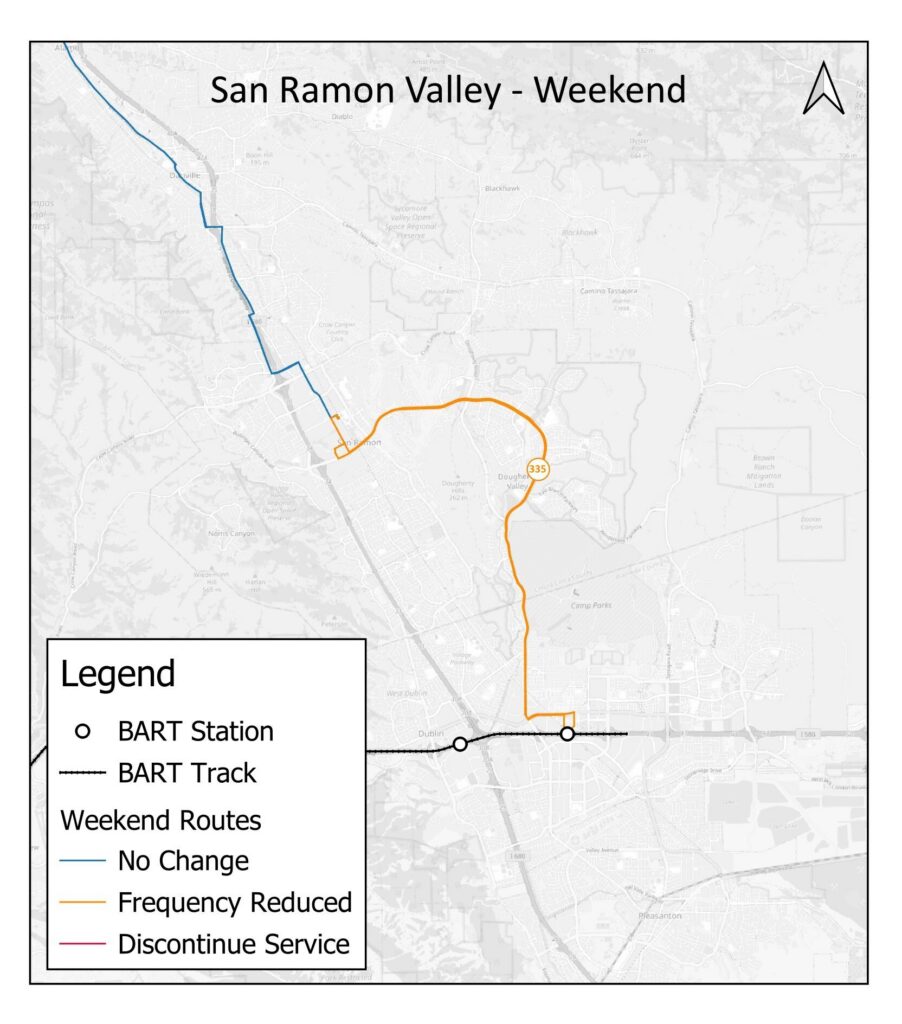
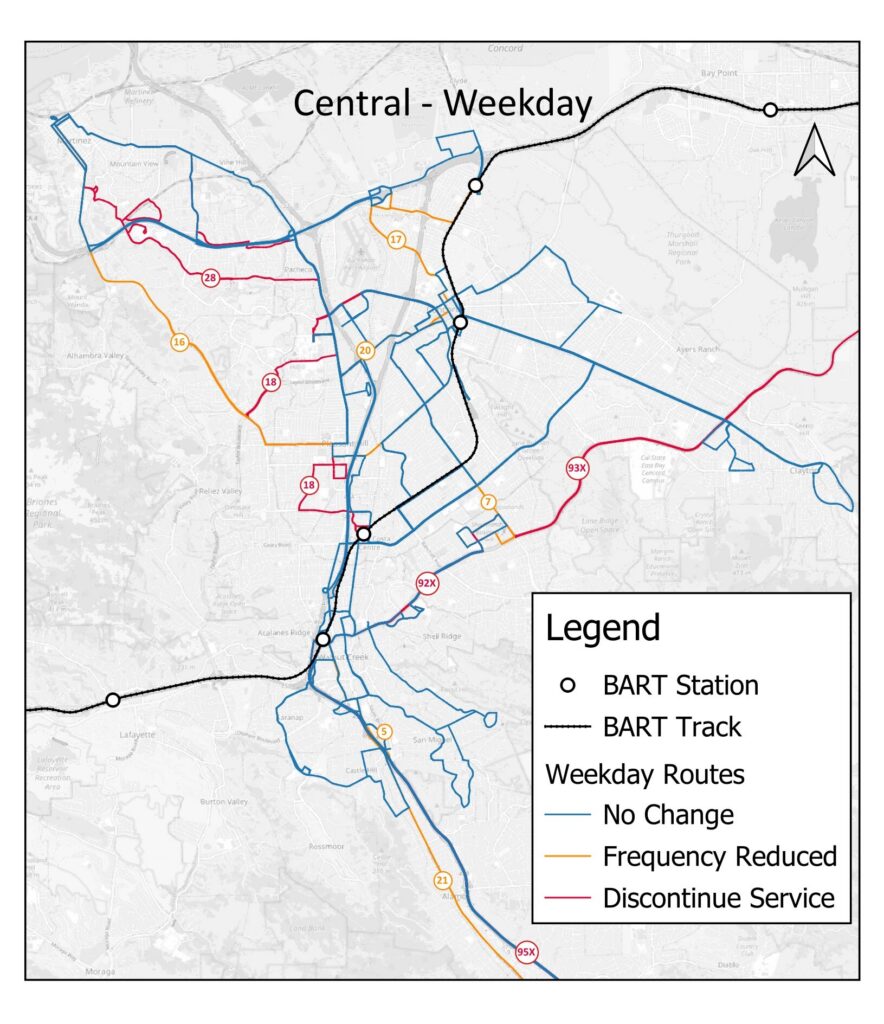
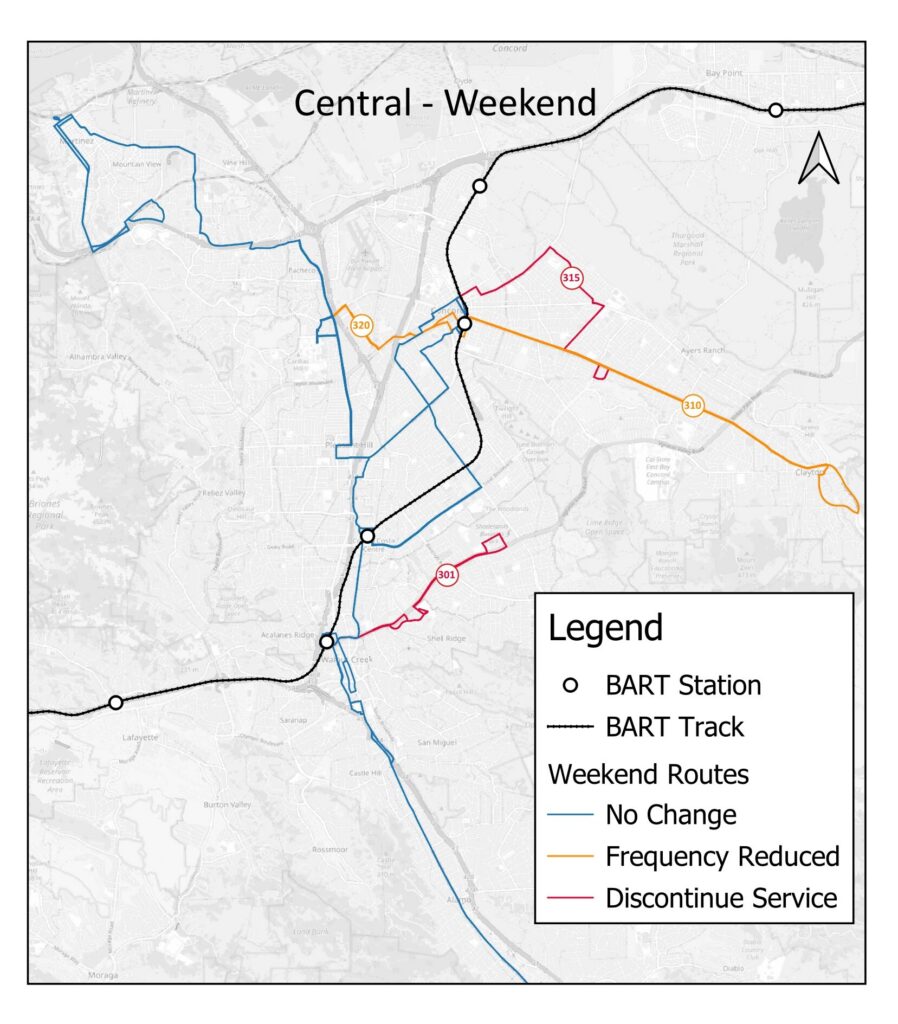
Like many public transit agencies across the Bay Area, County Connection is facing a budget challenge. To prepare for what may lie ahead, the County Connection Board of Directors has adopted an Alternative Service Plan which focuses on reducing costs through targeted changes to bus service, including eliminating some routes and reducing the frequency of service on others.
Where does our transit service stand today?
County Connection currently operates 33% less bus service than it did in 2008, due to multiple reductions in state transit funding. Today, we’re facing another financial challenge: a $6.5 million operating deficit. Much of our funding comes from sales tax revenue, which hasn’t kept pace with rising operating costs. In simple terms, it costs more to run our bus service than we’re bringing in. To maintain current service levels, we’ve had to rely on our financial reserves. But this isn’t a sustainable solution. Without additional funding, our Alternative Service Plan outlines the possibility of reducing bus service by another 22%.
This proposed plan is not a guarantee that service reductions will occur. Rather, it provides a roadmap for how we can reduce operating costs if additional funding does not become available.
We have broken out our service plan into three subregions; Lamorinda (Orinda, Moraga, Lafayette), San Ramon Valley (San Ramon, Danville), and Central County (Concord, Clayton, Pleasant Hill, Walnut Creek). Please see the proposed plan below.
What do these changes do to help with the budget deficit?
The changes proposed in the Alternative Service Plan would allow County Connection to maintain a core level of transit service while reducing operating expenses by approximately $6.5 million by July 2029, through a 22% systemwide reduction in service.
We do not want to reduce bus service.
Public transit is essential to the communities we serve, connecting people to work, school, healthcare, shopping, and other destinations throughout Central Contra Costa County. While reducing service is not a choice we’d like to make, it may be necessary given the current financial uncertainties.
What the Alternative Service Plan gives us are options; options that will allow us the flexibility to consider if difficult financial decisions do become necessary–helping ensure we can continue providing transit service to Central Contra Costa County, as we have since 1980.
We will provide more information here as it becomes available in the coming months. Thank you for your support.
Questions? Please contact us at help@cccta.org or call Customer Service at 925-676-7500.
Election Day is Tuesday, November 3, 2026! As the date approaches, if you plan on voting in person, it’s important to know where to find your polling place. Knowing where to go will help you avoid confusion on the day itself. So, take a moment to find your polling place and get ready to make your vote count—your voice is important!
If you’re looking for a public transit option to get to your polling place on Election Day, County Connection can get you there! See our table below, organized by city, and find a polling place in your area accessible by bus.
September is Transit Month, a Bay Area-wide celebration of public transportation and the communities it connects. County Connection is joining in on the fun with County Connection BINGO(what else would we call it?)! To play, visit participating local businesses along County Connection bus routes, collect BINGO stamps, and win prizes. Every BINGO wins!
The submission link is closed. Thank you for playing.
Grand Prize: Every BINGO puts you in the running!
Our Grand Prize Pot is still growing! The prizes are generously donated from our participating businesses. We will be adding more prizes are they come in. So far…it’s looking pretty good:
Cottage Jewel
$25 Gift Card, Necklace
Cuppa Yo Danville
$25 Gift Card
Flying Colors Comics
2 Flyer Color Comic Glasses
Ember Rest
Pokemon Prize Pack
Pot of Gold
Jumbo Bun Squishy
Vintage Vida
Sealed 1985 Pointer Sisters LP Vinyl Record, 1990s Paula Abdul cassette tape
Up the Creek Records
$25 Gift Card + Sticker Pack
Zachary’s Chicago Pizza
Free pizza of your choice
Who’s on board?
Some of our favorite local businesses are on the board (BINGO card), of course. These businesses range from food, to candy, to games, books, vintage clothing–lots of fun stuff! When you visit the store, just ask them to stamp your BINGO card.
Pick up a County Connection BINGO card at a participating business (see list above).
Visit participating businesses listed in each BINGO square. These businesses are located along our bus routes. (You don’t have to ride County Connection to the business locations, but we encourage you to do so.)
Collect business’s unique stamp in the matching square on your card.
Complete four stamps in a row—horizontally, vertically, or diagonally—to earn a BINGO. Once you have a BINGO, you may submit your card. One card per person. (More on that in a bit.)
Keep collecting stamps to complete additional rows, or BLACK OUT your entire card by filling every square.
Win Prizes – Every BINGO wins!
Complete a BINGO (four in a row) to win a prize from County Connection. Every BINGO wins a County Connection prize pack of a limited edition County Connection trucker cap, stickers, hotel-style key chains, pins, patches–lots of cool stuff. We’ll be giving out multiple prizes per BINGO. More BINGOs = more prizes.
Also, every completed BINGO also earns one entry into the Grand Prize drawing. BINGO prizes will be distributed at the end of September. The Grand Prize winner will be selected on October 2.
BLACK OUT Bonus: Fill every square (collect every stamp) on your card to receive eleven (11) entries into the Grand Prize drawing. That means, your name is entered for the drawing eleven times (all the possible BINGOs on a 4 x 4 card) plus a bonus entry for blacking out your card.
OFFICIAL RULES
BINGO cards are valid only during September 1-30, 2026.
One card submitted per person.
Only official stamps from participating County Connection BINGO businesses will be accepted. (Participating businesses will have official stamps.)
Participating businesses do not represent County Connection and County Connection does not represent businesses participating in County Connection BINGO.
Each participating business has one unique stamp that corresponds to a specific square on the BINGO card.
A BINGO consists of four consecutive squares completed horizontally, vertically, or diagonally.
Each completed BINGO (four stamps in a row) earns one prize and one Grand Prize entry.
BLACK OUT Bonus: Complete the entire card to receive eleven (11) entries into the Grand Prize drawing.
Participants may submit their card as soon as they earn a BINGO or continue collecting stamps throughout September to maximize their Grand Prize entries. (Again, one entry per person.)
All entries must be received by 10 a.m. on October 1, 2026.
Prizes are available while supplies last.
County Connection reserves the right to verify entries and disqualify incomplete, fraudulent, or multiple submissions under the same contact.
Need more transit action? Join the Bay Area Transit Month Ride Contest
Transit Month is celebrated across the Bay Area, and every transit ride you take can earn you entries into the Bay Area Transit Month Ride Contest. Simply log your rides throughout September to earn badges, compete with other riders, and qualify for additional raffle prizes from participating transit agencies. Every ride you log counts as another chance to win.
Why not do both? Ride County Connection to collect BINGO stamps, then log those same rides in the Transit Month Ride Contest for even more opportunities to win! Psst….the Ride Contest also has prizes.
Questions? Please contact Marketing at marketing@cccta.org or call Customer Service at 925-676-7500.
Viajar en transporte público por primera vez puede resultar intimidante, sobretodo para los jóvenes (y sus padres), pero no se preocupe: ¡estamos aquí para ayudarle! Ya sea que esté aprendiendo a leer un horario, a entender las rutas de autobús o a planear su primer viaje, le guiaremos a través de todo lo que necesita saber para convertirse en un usuario de transporte público seguro de sí mismo.
Explore nuestras guías sobre tarifas y pases de transporte público, rutas escolares, rutas locales y programas para jóvenes. A lo largo del camino, compartiremos consejos útiles, recomendaciones y recursos para que viajar en County Connection sea sencillo, seguro y sin estrés.¡Sí puede lograrlo!
Guía rápida: Lo más destacado
Solicite una tarjeta Clipper para jóvenes (Youth Clipper) (disponible para jóvenes de 6 a 18 años). Esto le da un 50% de descuento en el transporte público del Área de la Bahía.
Aproveche la tecnología; planifique su viaje todos los días. Al igual que consultar el pronóstico del tiempo, es una buena idea consultar Google o aplicaciones como Transit, donde puede averiguar si su autobús va a tiempo.
¡Pruébelo! Aprender a viajar en transporte público puede llevar algo de tiempo. Intente viajar en transporte público un día en el que no tenga prisa ni esté tratando de llegar a una cita (¡aunque esos también son buenos momentos para intentarlo!). Esto le ayuda a quitarle la presión y le permite tomarse su tiempo para ir adquiriendo experiencia.
Servicio de autobús escolar por distrito
Guía rápida: Rutas escolares
Servicio de autobús escolar de County Connection: County Connection ofrece servicio (nuestra “serie 600”) a los distritos escolares de Los autobuses de la serie 600 operan durante los días escolares únicamente y sus horarios se ajustan a los horarios de entrada y salida de clases en ciertas escuelas. Además de los autobuses de la serie 600, los estudiantes también pueden usar nuestros autobuses regulares, o rutas fijas, para llegar a la escuela. Nota: Los autobuses no son gratuitos para los estudiantes.
Encuentra la ruta de su escuela
Haga clic en el distrito o los distritos escolares para ver una lista de escuelas.
Pases de transporte gratuitos: Solicite el pase Pass2Class a partir de julio. Pass2Class es un programa ofrecido a través de 511 CCTA que brinda pases de transporte gratuitos en County Connection al inicio del año escolar. Los pases son limitados y requieren una solicitud.
Transporte a mitad de precio:Obtenga una tarjeta Youth Clipper. Las tarjetas Youth Clipper permiten a los jóvenes (de 5 a 18 años) viajar en el transporte público del Área de la Bahía con un 50% de descuento. Estas tarjetas son válidas todo el año y requieren una solicitud. (Consejo: Se puede obtener una tarjeta Youth Clipper el mismo día en County Connection.)
Tarifas de transporte público: Tarjetas, pases y efectivo
COSTO – Los autobuses no son gratuitos para los estudiantes, aunque existen formas de obtener un descuento del 50% o, en ocasiones, pases gratuitos a través de programas locales. Las opciones son las siguientes:
Youth Clipper es la mejor opción de pase de transporte público para todo el año para jóvenes de 5 a 18 años. Esta tarjeta requiere una solicitud, pero una vez tramitada, su hijo(a) podrá pagar viajes a la mitad del costo (descuento del 50%) de una tarjeta Clipper para adultos. Para solicitarla:
Envíe una solicitud: Los usuarios de entre 6 y 18 años pueden solicitar una tarjeta Youth Clipper por correo, correo electrónico o fax. Al enviar una solicitud, nos permite determinar si usted cumple con los requisitos.
Solicítela en persona: Los jóvenes pueden obtener la tarjeta en persona enCounty Connection, 2477 Arnold Industrial Way en Concord, de lunes a viernes, 8am-3pm.
Nuestro personal ofrece un “Puesto móvil” que se instala en distintos lugares del condado de Contra Costa. Todos los “Puestos móviles” cuentan con información sobre nuestros servicios y programas, incluidas las solicitudes para la tarjeta Youth Clipper. Consulte el calendario mensual del “Puesto móvil”.
Opciones adicionales: Su estudiante puede pagar en efectivo ($2.50) o usar una tarjeta bancaria (pagar con solo pasar la tarjeta, $2.50).
Pases de transporte gratuitos: Pass2Class es un programa de 511 CCTA que se pone en marcha al inicio del año escolar. El programa ofrece pases de transporte a los estudiantes, válidos para viajes ilimitados en los autobuses de County Connection. Hay un número limitado de pases disponibles en el centro del condado de Contra Costa y las solicitudes se reciben a partir de principios de julio (para una fecha de activación del 1 de agosto). Haga clic aquí para obtener más información y solicitar el pase Pass2Class.
Guía rápida: Horarios y puntos de horario
Los puntos de horario son complicados de explicar, pero es necesario entenderlos para poder leer un horario de autobús. Piense en los puntos de horario como las “paradas programadas” del autobús.El horario indica los tiempos estimados para estas paradas clave. Cuando espere en una parada de autobús entre dos puntos de horario, use el punto de horario anterior a su parada. Cuando se baje del autobús entre dos puntos de horario, use el punto de horario posterior a su parada.
Si su parada se encuentra entre dos puntos de horario, use el punto de horario anterior a su parada para calcular cuándo llegará el autobús.
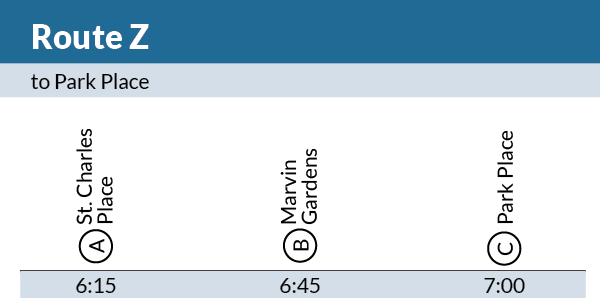
Cómo entender los puntos de horario: Ruta de ejemplo Z
Un punto de horario es una parada en la que el autobús tiene programado salir a la hora indicada en el horario. El autobús puede llegar un poco antes, pero no saldrá antes de la hora indicada. Usando el ejemplo a continuación:
Parada A – St. Charles Place: El autobús saldrá no antes de las 6:15:00 a.m.
Parada B – Marvin Gardens: El autobús saldrá no antes de las 6:45:00 a.m.
Parada C – Park Place: El autobús saldrá no antes de las 7:00 a.m.
Dado que Park Place es la última parada de este recorrido, es posible que el autobús espere allí un poco más antes de iniciar su siguiente recorrido en la dirección opuesta.
¿Qué pasa si mi parada no es un punto de horario?
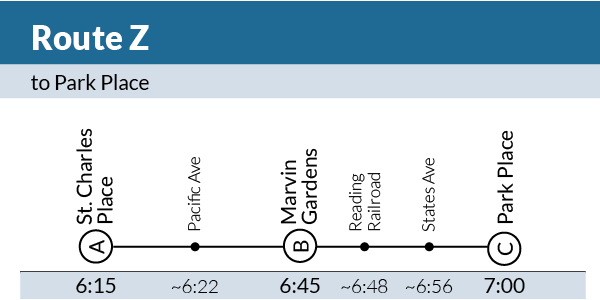
No todas las paradas de autobús aparecen en el horario. Los puntos de horario suelen estar ubicados en intersecciones importantes, centros de transporte público o, con mayor frecuencia, en áreas donde el autobús tiene espacio para orillarse (alejado del tráfico de la calle) y permanecer estacionado. Si su parada se encuentra entre dos puntos de horario, use el siguiente horario como guía:
El autobús llegará después de la hora indicada en el punto de horario anterior.
El autobús llegará antes de la hora indicada en el siguiente punto de horario.
Por ejemplo, si su parada es Pacific Ave, que se encuentra entre St. Charles Place (6:15) y Marvin Gardens (6:45), espere que el autobús llegue en algún momento entre las 6:15 y las 6:45. Para evitar perder el autobús, llegue a su parada unos minutos antes de la hora en que cree que llegará. También es una buena idea consultar aplicaciones como Google o Transit para ver información en tiempo real sobre la llegada de los autobuses.
TENGA EN CUENTA: Los horarios de los autobuses son una excelente herramienta de planificación, pero no son una garantía. El tráfico, las obras, los desvíos, el clima, la gran afluencia de pasajeros y otros retrasos inesperados pueden hacer que los autobuses circulen con retraso. Para conocer los tiempos de llegada más precisos, utilice rastreadores de autobuses en tiempo real como Google o Transit (una aplicación) antes de dirigirse a su parada. Un poco de flexibilidad puede ayudar a que su viaje sea menos estresante.
Guía rápida: Preguntas y respuestas
Nuestro personal de Servicio al Cliente está disponible de lunes a viernes, 6:30am-6:30pm al 925-676-7500.
Programe una llamada. Si su pregunta no es urgente, puede enviarnos un correo electrónico a customerservice@cccta.org ó marketing@cccta.org con su consulta y le responderemos por correo o le devolveremos la llamada.
Preguntas frecuentes (FAQs)
¿Cómo podemos contactarle?
¡Venga a vernos!: 2477 Arnold Industrial Way, Concord (Lun a vie, 8:00 am–3:00 pm)
Contacte al Servicio al Cliente: (925) 676-7500 (Lun a vie, 6:30 am–6:30 pm)
Yes. Most 600-series routes use 40’ buses that hold about 70 passengers (seated + standing).
¿Hay suficiente espacio para todos los estudiantes?
Sí. La mayoría de las rutas de la serie 600 utilizan autobuses de 40 pies con capacidad para unos 70 pasajeros (sentados y de pie).
¿Pueden viajar en los autobuses escolares personas que no son estudiantes?
Sí. County Connection es un servicio de transporte público, por lo que no podemos negar el abordaje a personas que no sean estudiantes si el espacio lo permite. Sin embargo, los autobuses de la serie 600 suelen estar llenos de estudiantes, por lo que rara vez se abordan personas que no sean estudiantes.
¿Se permiten bicicletas?
Sí. Todos los autobuses cuentan con portabicicletas delanteros con capacidad para dos bicicletas. Si el portabicicletas está lleno, los conductores pueden permitir que las bicicletas van dentro del autobús si el espacio lo permite.
¿Ofrecen servicio matutino a las escuelas?
No todas las rutas de la serie 600 operan por la mañana. Las siguientes rutas son solo por la tarde: 613, 615, 619, 622, 623, 626, 635. Para opciones de transporte compartido, conéctese a 511contracosta.org.
¿Sale el autobús de la escuela al final del día?
Los horarios de los autobuses están programados para coincidir con la última campana del día y no incluyen periodos extrahorarios (zero periods).
¿Con qué frecuencia circulan los autobuses de la serie 600 por la tarde?
Cada autobús realiza un viaje a la hora indicada. No hay viajes adicionales.
¿El conductor esperará a los estudiantes?
Sí. El autobús está programado para salir aproximadamente 10 minutos después de la hora de la campana. Si el conductor ve que aún hay estudiantes llegando a la parada, esperará hasta que todos hayan subido (por lo general, en un plazo de 3 minutos).
¿Hay más de un autobús por escuela?
Algunas escuelas cuentan con varias rutas y otras pueden tener dos autobuses para la misma ruta debido a la alta demanda.
¿Qué pasa si mi hijo pierde el autobús?
Todos los autobuses de la serie 600 hacen un solo viaje. Si un autobús de ruta fija también presta servicio a la escuela, podría haber otra opción disponible pero no está diseñada en función de los horarios de las campanas y el tiempo de espera podría ser de hasta una hora.
¿El autobús se detiene en todas las paradas?
Sí, si hay pasajeros esperando o si un pasajero solicita una parada (tirando del cordón amarillo).
¿Los estudiantes sabrán dónde está la parada?
Sí. La mayoría de las paradas están frente a la escuela. Busque el letrero de la parada de autobús de County Connection. (En WCI, algunas rutas se detienen en Civic Dr., detrás de la escuela.) Si no está seguro(a) de cuál es la ubicación exacta para bajar o subir, por favor, comuníquese con el Servicio al Cliente (925-676-7500) para aclararlo.
¿Cómo puedo encontrar la ubicación exacta de la parada?
Busque la dirección o la intersección en Google Maps y busque el ícono de la parada de autobús. Si no está seguro(a) de la ubicación exacta, por favor, comuníquese con el Servicio al Cliente (925-676-7500).
¿Puedo rastrear cuándo mi hijo sube o baja del autobús?
No. No puede rastrear a personas específicas, pero sí puede:
Rastrear la ubicación de los autobuses en countyconnection.com seleccionando la ruta y viendo el mapa en vivo.
Usar el Transit app para obtener información de transporte en tiempo real.
¿Cuál es la diferencia entre una tarjeta Clipper para jóvenes y una para adultos?
Se ven iguales, pero las tarjetas para jóvenes están vinculadas a la fecha de nacimiento y aplican automáticamente un descuento del 50% hasta los 19 años. Las tarjetas Clipper para adultos tienen la misma función, excepto que no se aplica el descuento.
¿Incluye el pase Pass2Class una tarjeta Clipper?
No. Son programas distintos con solicitudes separadas.
¿Se puede agregar una tarjeta Clipper Youth a la aplicación o al monedero digital?
Sí. Primero necesita la tarjeta física para cargarla en el monedero de su celular y recibir el descuento. Una vez que la tarjeta esté cargada en su celular, la tarjeta física ya no sirve.
¿Cuánto tiempo toma obtener una tarjeta Clipper Youth?
En persona en la oficina de Concord (L a V, 8:00a–3:00p): El mismo día (con los documentos requeridos).
En línea: Unas semanas. La tarjeta se envía por correo después de la verificación
Puesto móvil: La tarjeta se enviará por correo en un plazo de 2 días hábiles, se puede recoger en nuestra oficina o se puede programar su recogida en un evento del puesto móvil.
¿Mi hijo(a) debe estar presente para presentar la solicitud?
No. Traiga su identificación, acta de nacimiento o pasaporte para la verificación.
¿Pueden los estudiantes pagar en efectivo sin una tarjeta Clipper?
Sí, pero la tarifa en efectivo es de $2.50 (solo cambio exacto) sin transbordos Con una tarjeta Clipper Youth, la tarifa es de $1.00 e incluye transbordos.
¿A qué hora llega el autobús en los días de horario reducido?
Los autobuses se ajustan al horario de las campanas. En nuestro sitio web, diríjase a la página de rutas escolares y desplácese hasta el final para descargar el calendario escolar. El calendario escolar indica las fechas y horarios de los días de salida temprana, así como los días en que no se presta el servicio debido a días sin clases.
¿Qué pasa si el autobús está lleno?
Si un autobús alcanza su capacidad máxima, no pueden subir más estudiantes. La mayoría de las rutas escolares solo cuentan con un autobús. Si hay constantemente un exceso de pasajeros, nuestro equipo de planificación revisa los datos para considerar la posibilidad de agregar servicio, pero no está garantizado.
¿Qué pasa con los estudiantes de la zona de Livorna Park/Rudgear? (Monte Vista High)?
Los estudiantes pueden tomar la Ruta 623 hasta San Ramon Valley Blvd y hacer transbordo a la Ruta 21.
¿Qué tan confiable es el servicio de la serie 600?
Muy confiable. Las rutas escolares son una prioridad máxima. Si un autobús se retrasa, nuestro departamento de transporte notifica directamente a las escuelas.
Questions? Please contact Marketing at marketing@cccta.org or call Customer Service at 925-676-7500.
Taking public transit for the first time can feel intimidating, especially for youth riders (and their parents), but don’t worry—we’re here to help! Whether you’re learning how to read a schedule, understand bus routes, or plan your first trip, we’ll walk you through everything you need to know to become a confident transit rider.
Explore our guides on fares and transit passes, school routes, local routes, and youth programs. Along the way, we’ll share helpful tips, recommendations, and resources to make riding County Connection simple, safe, and stress-free.You’ve got this!
Quick Guide: Hot Takes
Apply for a Youth Clipper Card (available for youth 5-18). This gives a 50% discount on Bay Area transit, including buses, trains, and ferries (but sadly, not cable cars or Amtrak).
Embrace technology; plan your trip every day. Just like checking the weather forecast, it’s a good practice to check Google or apps like Transit where you can find out if your bus is running on time.
Give it a try! Learning to ride transit can take some time. Try just taking transit on a day when you’re not in a rush or trying to make an appointment (though those are good times to try, too!). This helps take the pressure off, and you can take your time building your knowledge.
School Bus Service by District
Quick Guide: School Routes
County Connection School Routes: County Connection offers service (our “600-series”) to schools in Concord, Walnut Creek Lamorinda, and San Ramon Valley. The 600-series buses operate during school daysonly and are scheduled around bell times at select schools. In addition to the 600-series buses, students may also use our regular bus, or fixed routes to get to school. Note: The buses are not free for students.
Find Your School’s Route
Click the school district(s) to reveal a list of schools.
Free Transit Passes: Apply for Pass2Class as early as July. Pass2Class is a program offered through 511 CCTA that offers free transit passes on County Connection at the start of the school year. Passes are limited and require an application.
Half-Off Transit:Get a Youth Clipper card. Youth Clipper cards allow youth (5-18) to ride Bay Area transit for 50% off. These cards are good year round and require an application. (Protip: You can get a Youth Clipper card same day at County Connection’s offices.)
Transit Fares: Cards, Passes, & Cash
COST – The buses are not free for students, though there are ways for students to get a 50% discount, and there are a limited number of free passes available through area programs. The options are as follows:
Youth Clipper is the best year-round transit pass option for youth ages 5-18. This card requires an application, but once done, it gives a 50% discount on transit until you turn 19. To apply:
Submit an application: Riders ages 6-18 can apply for a Youth Clipper card by mail, email or fax. By submitting an application, we are able to determine your eligibility.
Apply in person: Youth riders can get a card in person at County Connection, 2477 Arnold Industrial Way in Concord, Monday-Friday, 8am-3pm.
Our staff offers a Mobile Lobby that pops up around Contra Costa County. All Mobile Lobbies have information on our services and programs, including applications for Youth Clipper. See the Mobile Lobby schedule for the month.
Additional options: Your student may also pay cash ($2.50), or use a bank card (“tap-and-pay”, $2.50).
Free Transit Passes: Pass2Class is a program by 511 CCTA and runs at the start of the school year. The program offers transit passes to students, valid for unlimited rides on County Connection buses. There is a limited number of passes available within Central Contra Costa County and applications open in early July (for an August 1 activation date). Click here to learn more and apply for Pass2Class.
Quick Guide: Schedules & Timepoints
Timepoints are complicated to explain but necessary to understand in order to read a bus schedule. Think of timepoints as the bus’s “appointment stops.” The schedule lists estimated times for these key stops.
If your stop is between two timepoints, use the timepoint before you stop to estimate when your bus will arrive.
Understanding Timepoints: Sample Route Z
A timepoint is a stop where the bus is scheduled to leave at the time shown on the schedule. The bus may arrive a little early, but it won’t leave before the listed time. Using the example below:
Stop A – St. Charles Place: The bus will leave no earlier than 6:15 a.m.
Stop B – Marvin Gardens: The bus will leave no earlier than 6:45 a.m.
Stop C – Park Place: The bus will leave no earlier than 7:00 a.m.
What if my stop isn’t a timepoint?
Not every bus stop appears on the schedule. Timepoints are typically located at major intersections and transit centers. If your stop is between two timepoints, use the schedule below as a guide:
The bus will arrive after the time listed at the previous timepoint.
The bus will arrive before the time listed at the next timepoint.
For example, if your stop is Pacific Ave, which is between St. Charles Place (6:15) and Marvin Gardens (6:45), expect the bus sometime between 6:15 and 6:45. To avoid missing your bus, arrive at your stop a few minutes before you think it will arrive. It’s also a good rule of thumb to check apps like Google or Transit to see realtime bus arrival information.
PLEASE NOTE: Bus schedules are a great planning tool, but they aren’t a guarantee. Traffic, construction, detours, weather, heavy passenger activity, and other unexpected delays can cause buses to run behind schedule. For the most accurate arrival times, use real-time bus trackers like Google Maps or the Transit app before heading to your stop. Giving yourself a little extra time can help make your trip less stressful.
Quick Guide: Questions & Answers
Our Customer Service staff are available Monday-Friday, 6:30am-6:30pm at 925-676-7500.
Schedule a call. If your question is not urgent, you can email us at customerservice@cccta.org or marketing@cccta.org with your question and we’ll either reply to your email, or call you back.
Frequently Asked Questions (FAQs)
How can we contact you?
Come see us!: 2477 Arnold Industrial Way, Concord (Mon–Fri, 8:00 am–3:00 pm)
Yes. Most 600-series routes use 40’ buses that hold about 70 passengers (seated + standing).
Do non-students ride the school routes?
Yes. County Connection is public transit. However, non-student boarding rarely happen on our 600-series routes.
Are bikes allowed?
Yes. All buses have front racks for two bikes. If the rack is full, drivers may allow bikes inside if space permits.
Do you provide morning service to schools?
Not all 600-series routes run in the morning. The following routes are afternoon only: 613, 615, 619, 622, 623, 626, 635. For carpool options, visit 511contracosta.org.
Does the bus leave the school at the end of the day?
Buses are scheduled with the final bell for the day and does not include zero periods.
How often do 600-series buses run in the afternoon?
Each bus makes one trip at the posted time. There are no extra trips.
Will the driver wait for students?
Yes. The bus is scheduled to leave approximately 10 minutes after the bell time. If the bus operator sees students still coming to the bus stop, they will remain at the bus stop until they are boarded (typically within 3 minutes).
Is there more than one bus per school?
Some schools have multiple routes and some may have two buses for the same route due to high demand.
What if my student misses the bus?
All 600-series buses make only one trip. If a regular bus route that also serves the school, another option may be available but is not designed around bell times and a waiting time could be up to one-hour.
Does the bus stop at every stop?
Yes, if passengers are waiting or a rider requests a stop (pull the yellow cord).
Will students know where the stop is?
Yes. Most stops are in front of the school. Look for the County Connection bus stop sign. (At WCI, some routes stop on Civic Dr. behind the school.) If you are not sure of the exact drop off or pick-up location is, please contact Customer Service (925-676-7500) to clarify.
How do I find the exact stop location?
Search the address or intersection on Google Maps and look for the bus stop icon. If you are not sure of the exact location, please contact Customer Service (925-676-7500).
Can I track when my child gets on/off the bus?
No. You can’t track individuals, but you can:
Use the Google Maps and the Transit app for real-time bus location info.
Track bus locations on countyconnection.com by selecting the route and viewing the live map.
What’s the difference between a Youth and Adult Clipper Card?
They look the same, but youth cards are linked to birthdate and automatically apply a 50% discount until age 19. Adult Clipper Cards have the same function except the discount is not applied.
Does Pass2Class include a Clipper Card?
No. They are separate programs with separate applications.
Can a Youth Clipper Card be added to the app/wallet?
Yes. You need the physical card first to load it into your phone wallet and receive the discount. Once the card is loaded onto your phone, the physical card is not longer of use.
How long does it take to get a Youth Clipper Card?
In-person at Concord office (M–F, 8:00a–3:00p): Same day (with required documents).
Online: A few weeks. Card is mailed after verification
Mobile Lobby: Card will be mailed within 2 business days, picked up at our office, or schedule to pick up at a mobile lobby event.
Does my child need to be present to apply?
No. Bring their ID, birth certificate, or passport for verification.
Can students pay cash without a Clipper Card?
Yes, but cash fare is $2.50 (exact change only) and doesn’t include transfers. With a Youth Clipper Card, the fare is $1.00 and includes transfers.
What time does the bus come on minimum days?
Buses adjust to the bell schedule. On our website, go to the school route page and scroll to bottom to download the school calendar. The school calendar provides dates and times of early dismissal days and the days when service is not provided due to non-school days.
What if the bus is full?
If a bus reaches capacity, no additional students can board. Most school routes only have one bus and if overcrowding becomes an issue, we will sometimes send a second bus. If the overcrowding is consistent, our planning team reviews data to consider adding service, but it’s not guaranteed.
What about students in the Livorna Park/Rudgear area (Monte Vista High)?
There’s no direct bus. Students can take Route 623 to San Ramon Valley Blvd and transfer to Route 21.
How reliable is the 600-series service?
Very reliable. School routes are a top priority. If a bus is delayed, our transportation department notifies schools directly.
Questions? Please contact Marketing at marketing@cccta.org or call Customer Service at 925-676-7500.
WHY ARE THERE CHANGES IN SERVICE? County Connection is making time adjustments to some of our routes to better align with neighboring transit agency schedules and improve on time performance. The updated schedules are intended to provide a more seamless transit experience across agencies. If you have questions, contact Customer Service 925-676-7500.
¿POR QUÉ HAY CAMBIOS EN EL SERVICIO? County Connection está haciendo ajustes de tiempo en algunas de nuestras rutas para alinearse mejor con los horarios de las agencias de transporte vecinas y mejorar la puntualidad. Los horarios actualizados están destinados a proporcionar una experiencia de tránsito más fluida entre las agencias. Si tiene preguntas, comuníquese con Servicio al Cliente al 925-676-7500.
Do you have questions or thoughts on the service changes you’d like to share? Email planning@cccta.org and we’ll be glad provide a response or hear what you have to say.
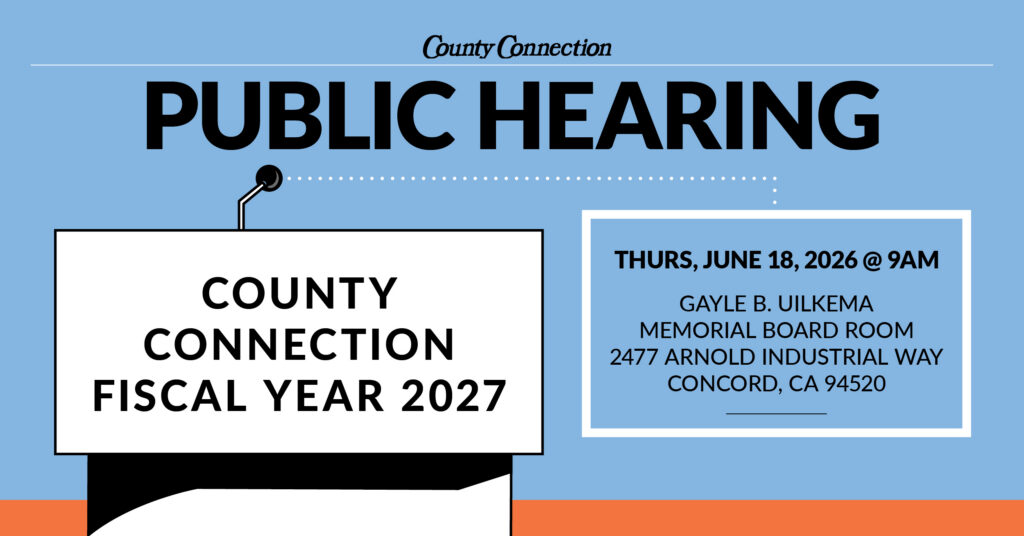
Notice of Public Hearing – Thursday, June 18, 2026, 9:00 am
Notice is hereby given that:
The Central Contra Costa Transit Authority’s (County Connection’s) proposed Fiscal Year 2027 budget is available for review at the County Connection offices, 2477 Arnold Industrial Way, Concord, California, or on the website, www.countyconnection.com in the Agenda section of the Report of Standing Committee – Administration and Finance Committee.
On Thursday, June 18, 2026, at 9:00 a.m., County Connection will hold a public hearing at the Board of Directors meeting on the social, environmental, and economic impacts as they relate to the FY 2027 budget at its offices, 2477 Arnold Industrial Way, Concord, California. A taxpayer may appear and be heard at that time and place regarding an increase, decrease, or omission of any item in the budget or inclusion of additional items. The hearing will also include the status of County Connection employee vacancies in accordance with Assembly Bill (AB) 2561. At the hearing, the Board will afford an opportunity for interested persons to be heard and instructions will be provided on the website or public comment may be submitted via email to hill@cccta.org.
Concord, CA – May 29, 2026 – County Connection supports the key findings and recommendations from the California State Auditor regarding East Bay Transit Agencies. County Connection itself, along with the five other transit agencies audited (AC Transit, Livermore-Amador Valley Transit Authority, Tri Delta Transit, and WestCAT), received no specific findings or recommendations.
“This audit reflects the hard work and dedication of our employees and leadership team,” said Bill Churchill, General Manager of County Connection. “We remain committed to managing public resources responsibly while continuing to provide safe, reliable, and efficient transit service to our community.”
The audit found that:
East Bay transit agencies regularly coordinate, both directly and through regional initiatives, and that there are few barriers to their collaboration;
An audit conducted while riding 25% of East Bay transit agencies’ bus routes that cross service areas found no significant obstacles for transit riders including transferring between agencies;
All East Bay transit agencies anticipate challenges in meeting the State’s requirements to purchase zero-emission vehicles because of their high cost and lack of direct funding;
Five of the six audited agencies may exhaust their reserves within the next one to five years and may need to reduce service without additional funding;
Merging or combining the agencies would not resolve the financial challenges of the agencies and would likely increase labor costs;
Board Chair Robert Storer said the positive findings reinforce public confidence in the agency’s operations and long-term planning efforts. “Our riders, employees, taxpayers, and funding partners deserve accountability and transparency,” Storer said. “These results demonstrate that the agency is meeting those expectations while positioning itself for a sustainable future.”
The audit recommended that:
MTC should establish realistic and attainable time frames for each of its transit action plan items by setting major milestones and subtasks for completion;
To address the risk that transit agencies may have to reduce services due to rising operation costs, MTC should, by January 2027, begin identifying additional funding sources that it could direct to transit agencies at risk of reducing services;
To ensure that agencies can comply with the California Air Resources Board’s (CARB) mandate to make all new bus purchases zero-emission starting in 2029, the Legislature should consider extending the deadline or allocating new funds to the transit agencies to purchase zero-emission vehicles.
County Connection, who delivers almost three million rides to the region annually, has long worked to advance collaborative transit initiatives. Recent examples include the One Seat Regional Ride program with Tri Delta Transit, WestCAT, and Wheels to provide a transfer-free service for passengers using paratransit within Contra Costa County and the Tri-Valley region; a summer Youth Ride Free program providing free rides to all passengers 18 years and younger within Contra Costa and Alameda Counties, and two pilot programs with MTC’s Regional Mapping and Wayfinding Project to test the implementation of a new unified design for all transit maps and signage across the entire Bay Area region.
About County Connection County Connection provides public transportation services throughout central Contra Costa County, serving approximately 2.8 million riders annually through bus and paratransit services.
Questions or feedback? We’d love to hear your thoughts. Reach out to our Marketing Department at marketing@cccta.org
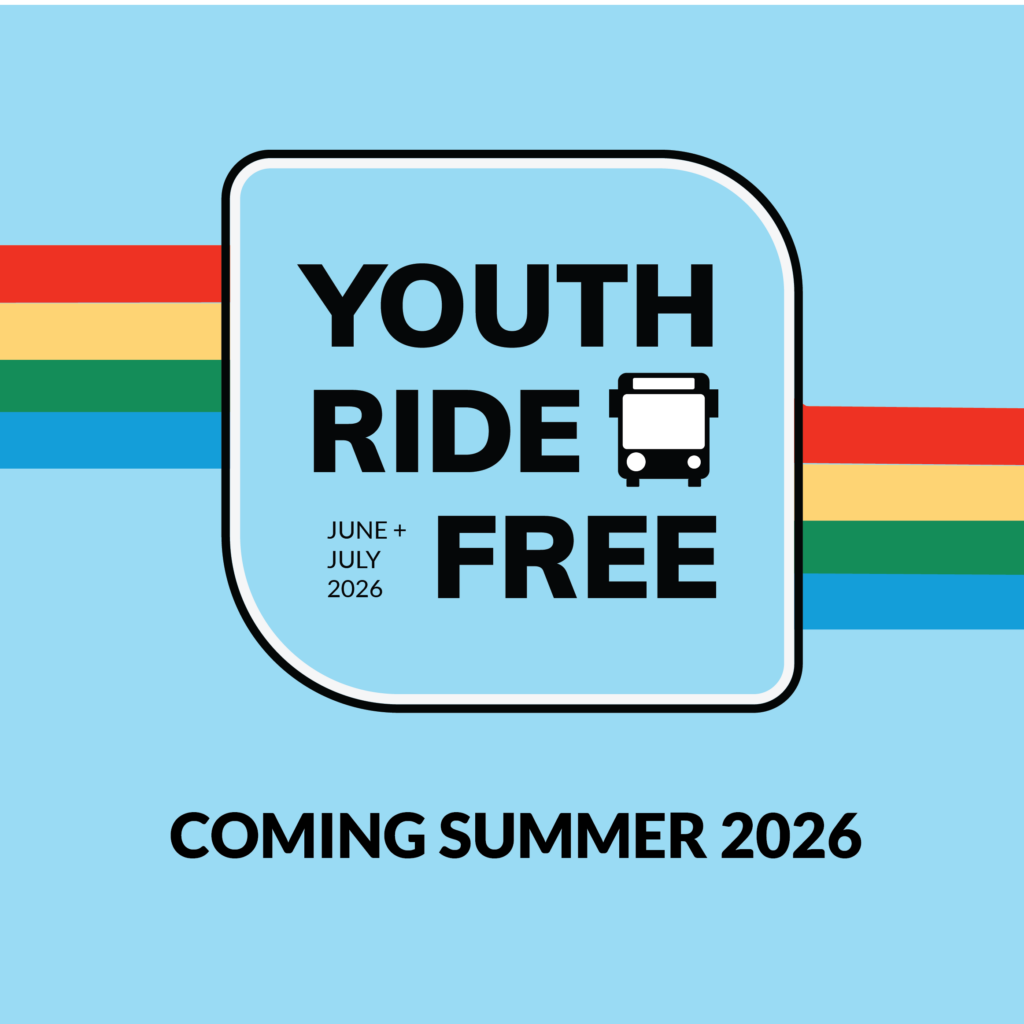
Contra Costa County, CA — Following a highly successful youth program last summer, County Connection, Tri Delta Transit, and WestCAT will continue the Youth Ride Free program, offering fare-free rides on all fixed-bus routes for youth up to 18 years of age from June 1 through July 31, 2026. County Connection will also extend the Youth Ride Free program to its LINK paratransit service.
With strong participation and widespread grassroots community support, Youth Ride Free has quickly become a cornerstone program for expanding access and mobility for young riders across the three connecting service areas in Contra Costa County. By removing barriers—no fares, applications, IDs, or special passes required—young riders can simply get on board, making transit more accessible than ever.
“The Youth Ride Free program provides a vital mobility option for our youth in eastern Contra Costa,” said CEO Rashidi Barnes. “This valuable initiative allows our young people to participate freely in summer sports and school programs, connect with friends and family, all without relying on a car. Furthermore, as a teenager growing up in the Bay Area, public transportation enabled me to secure a summer job, which helped me support the local economy and develop important life skills.”
Last year alone, Tri Delta Transit transported 40,000 youth during June and July and expects to reach similar ridership levels this year. Recognizing the significant impact of the program, Tri Delta Transit thanks District 3 County Supervisor Diane Burgis and District 5 County Supervisor Shanelle Scales-Preston for their financial commitment, which has ensured the continuation of the 2026 Youth Ride Free program in eastern Contra Costa County.
Says Rob Thompson, General Manager of WestCAT, “Our goal this summer is simple—remove barriers and make it easier for young people to get where they need to go. By offering free rides, we’re supporting opportunity, independence, and stronger connections across our community.”
During last year’s Youth Ride Free pilot, WestCAT saw a 1,170% increase in youth ridership compared to the previous year. In 2025, WestCAT was the only participating agency that required students to show IDs to board—a requirement that did not significantly impact ridership. In 2026, WestCAT will eliminate this requirement, further aligning with the program’s barrier-free approach.
County Connection’s program also demonstrated a transformative impact on youth mobility, with more than 25,000 free rides recorded over two months—an increase of more than 1,600% compared to previous summer programs. This growth was driven in large part by strong community support, including school districts, parents, and local organizations that helped raise awareness and encourage participation.
“I’m very proud of our staff for creating a program that allows our students to ride our buses,” said Robert Storer, Board Chair of County Connection. “When a program takes what was near stagnant youth ridership in the summer months and boosts it to 25,000 rides, as it did with Youth Ride Free, that’s a powerful measure of success. It shows what’s possible when we remove barriers and work closely with our community.”
Beyond increased ridership across all participating agencies, the program also shifted how young people travel, attracting many first-time riders. While Youth Ride Free removes fares for riders, all three agency-led programs are supported through alternative, short-term funding sources.
As Contra Costa and other Bay Area transit agencies navigate an uncertain long-term funding landscape, initiatives like Youth Ride Free represent a strategic investment in cultivating the next generation of transit riders. Building on this momentum, County Connection, Tri Delta Transit, and WestCAT will continue working closely with regional partners to strengthen transit connections and expand opportunities for youth throughout Contra Costa County.
Media Contacts:
County Connection Ryan Jones Manager of Marketing & Communications rjones@cccta.org | 925-680-2037
Tri Delta Transit Leeann Loroño Manager of Customer Service and Marketing llorono@eccta.org | 925-754-6622
As the cost of living continues to rise, more people are turning to public transit as a practical way to save money while getting where they need to go. Across the Bay Area, ridership is climbing, with BART, Caltrain, and Muni all reporting record-breaking post-pandemic ridership this March. And we’re seeing that same momentum here at County Connection.
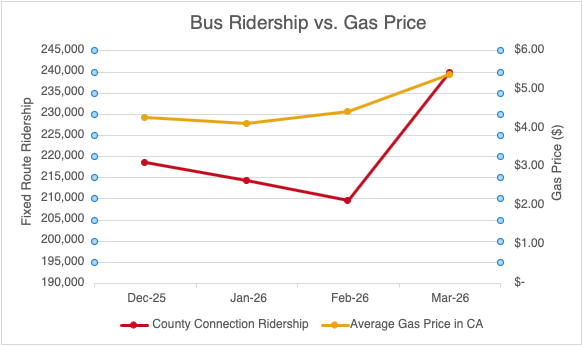
While ridership has continued to grow since the pandemic, March saw an unusually large year-over-year increase, with 5% more riders compared to March of last year. In total, nearly 240,000 people rode County Connection in March 2026, with an average of about 9,700 weekday riders—making it our strongest March since 2019.
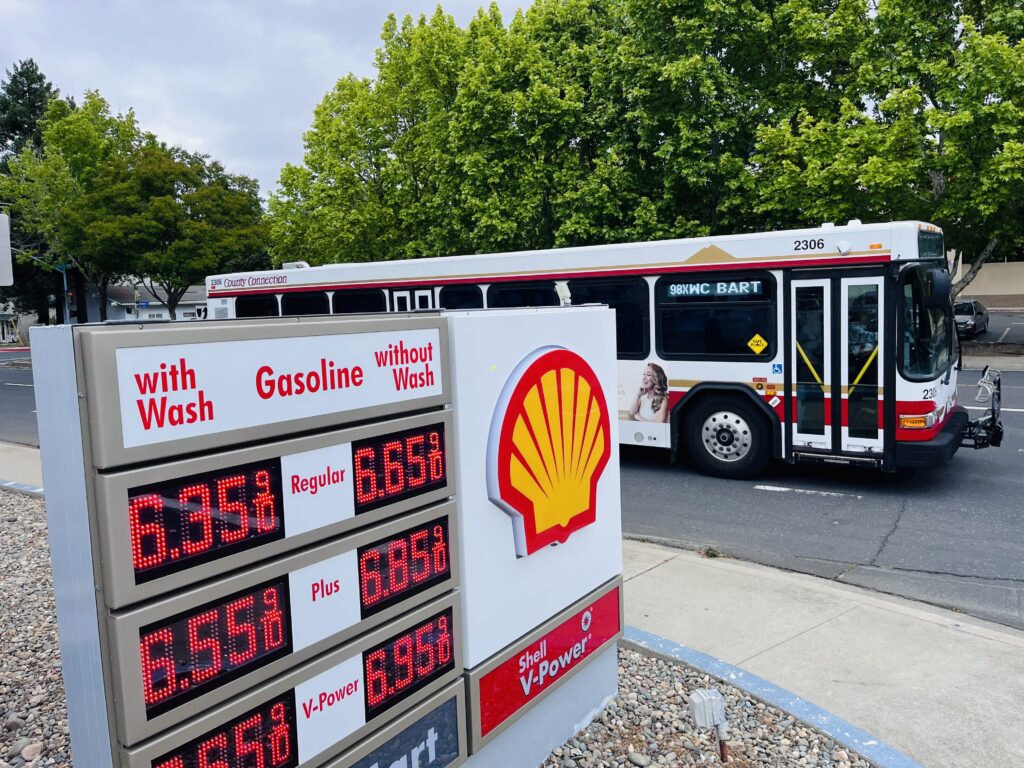
At the same time, we recognize that this growth is closely tied to real financial pressures facing our community. Rising fuel costs, in particular, continue to strain household budgets. According to the U.S. Energy Information Administration, the national average price of gasoline rose from $2.93 per gallon in January 2026 to $4.13 in March—a 41% increase. In California, prices climbed from $4.15 in January to $5.83 in March, a 40% jump. While transit agencies also feel the impact of rising fuel costs, these conditions are prompting more people to consider transit as a reliable and cost-effective alternative.
That shift isn’t limited to the weekday commute. Weekend ridership is also growing, with more people choosing transit for shopping, dining, and recreation. In March, Saturday ridership was 36% higher than in March 2019—the largest post-pandemic increase we’ve seen. These gains highlight transit’s role not just in getting people to work, but in supporting local businesses and contributing to the region’s broader economic recovery.
Table A: The line graph above shows a correlation with the average gas price per gallon in CA since and County Connection ridership from December 2025-March 2026. As the price of gas (yellow line) increases, so does the County Connection ridership (red line).
As demand grows, continued investment in transit will be key to sustaining this momentum and better serving the communities that rely on us every day. And as the cost of living—and especially gas prices—continues to fluctuate, County Connection remains a steady and reliable option, offering affordable, accessible transit since 1980. Whether you’re making the switch for the first time or returning to the bus, we’re here to help you get around central Contra Costa and perhaps give your wallet a well-deserved break.
Questions or feedback? We’d love to hear your thoughts. Reach out to our Marketing Department at marketing@cccta.org!